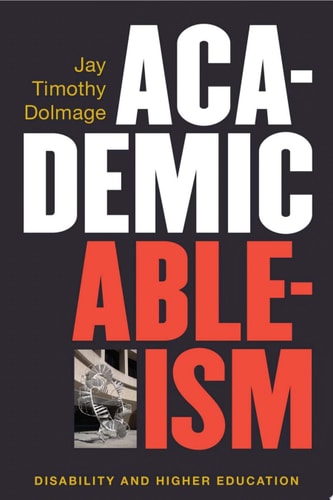
Academic Ableism: Disability and Higher Education
0
0
As an Amazon Associate and affiliate partner, Menrva Books earns from qualifying purchases. Learn more
Author Description
Academic Ableism brings together disability studies and institutional critique to recognize the ways that disability is composed in and by higher education, and rewrites the spaces, times, and economies of disability in higher education to place disability front and center. For too long, argues Jay Timothy Dolmage, disability has been constructed as the antithesis of higher education, often positioned as a distraction, a drain, a problem to be solved. The ethic of higher education encourages students and teachers alike to accentuate ability, valorize perfection, and stigmatize anything that hints at intellectual, mental, or physical weakness, even as we gesture toward the value of diversity and innovation. Examining everything from campus accommodation processes, to architecture, to popular films about college life, Dolmage argues that disability is central to higher education, and that building more inclusive schools allows better education for all.
Menrva's Summary
THE THESIS
This book investigates the pervasive influence of ableism within higher education institutions. Jay Timothy Dolmage argues that disability has been historically framed as antithetical to academic success, creating an environment that prioritizes ability and perfection while stigmatizing perceived weaknesses. By examining campus structures, policies, and cultural representations, the book demonstrates how disability is intrinsically linked to the educational experience. Ultimately, it posits that embracing inclusivity for disabled individuals enhances the educational environment for everyone.
THE SCOPE MAP
- Analysis of how disability is constructed and perpetuated within higher education.
- Examination of campus accommodation processes and their limitations.
- Critique of higher education architecture and its impact on accessibility.
- Deconstruction of popular films depicting college life through a disability lens.
- Argument for disability studies as central to understanding institutional critique.
- Exploration of the economic and temporal dimensions of disability in academia.
- Strategies for creating more inclusive educational spaces for all students and staff.
THE AUTHORITY PERSPECTIVE
The book is recognized for its critical examination of ableism in academic settings, drawing from disability studies and institutional critique. It challenges the traditional view of disability as a deficit within higher education, instead positioning it as a central element of the academic experience. The work is noted for its comprehensive approach, analyzing various facets of university life from policy to cultural representation. By advocating for inclusive practices, the book suggests that accommodating disability benefits the entire educational community.
Page Count:
244
Publication Date:
2017-11-22
Publisher:
University of Michigan Press
ISBN-10:
047205371X
ISBN-13:
9780472053711
Non-Fiction
Politics
History
Sociology
Higher Education
Social justice
Community Tags
Similar Books