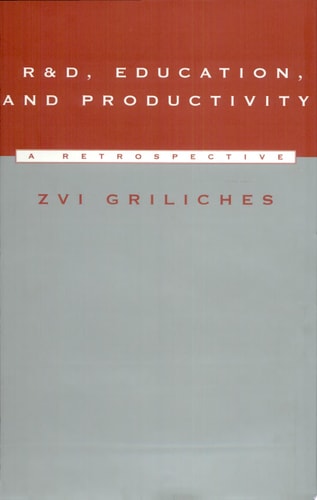
R&D, Education, and Productivity: A Retrospective
0
0
As an Amazon Associate and affiliate partner, Menrva Books earns from qualifying purchases. Learn more
Author Description
Zvi Griliches was a modern master of empirical economics. In this short book, he recounts what he and others have learned about the sources of economic growth. This book conveys the way he tackled research problems. For Griliches, economic theorizing without measurement is merely the fashioning of parables, but measurement without theory is blind. Judgment enables one to strike the right balance. The book begins with economists' first attempts to measure productivity growth systematically in the 1930s. In the mid-1950s these efforts culminated in a startling puzzle. The growth of measured inputs like labor and capital explained only a fraction of the growth of national output. Economists called this phenomenon "efficiency" or "technical change" or "the residual." However, Griliches observes that the most accurate name was a "measure of our ignorance." What explained the rest of economic growth quickly became one of the most important questions in economics. Over the next thirty years, Griliches and his colleagues and students looked for various components of the residual in education (the formation of human capital), investment (the formation of physical capital), and research and development. In 1973, after the oil price shocks, productivity growth slowed and the residual almost disappeared. Since the shocks were a short-term phenomenon, they could not account for the slowdown. A main focus of this book is therefore the puzzle of the productivity slowdown and how to date it and how to explain it.
Menrva's Summary
THE THESIS
This book examines the historical evolution of understanding economic growth and the persistent puzzle of the productivity slowdown. Zvi Griliches, a distinguished empirical economist, traces the development of thought on economic growth, from early attempts to measure productivity in the 1930s to the mid-1950s puzzle where measured inputs could not account for output growth. He highlights the concept of the
THE SCOPE MAP
- The historical attempts to measure productivity growth and the emergence of the "residual" or "technical change" puzzle.
- The investigation into the sources of economic growth, including human capital (education), physical capital (investment), and research and development.
- The analysis of the productivity slowdown that began in the 1970s and its potential causes.
- Griliches's perspective on the interplay between economic theorizing and empirical measurement.
THE AUTHORITY PERSPECTIVE
This book is regarded as a concise yet insightful retrospective by a leading figure in empirical economics. It offers a personal account of how economists grappled with fundamental questions about economic growth and productivity. The work is particularly valuable for its clear articulation of the "residual" problem and the subsequent research efforts to explain it. Griliches's emphasis on the balance between theory and measurement provides a critical framework for understanding economic research.
Page Count:
127
Publication Date:
2000-01-01
Publisher:
Harvard University Press
ISBN-10:
0674003438
ISBN-13:
9780674003439
Non-Fiction
Economics
History
Economic Growth
Productivity
Community Tags
Similar Books