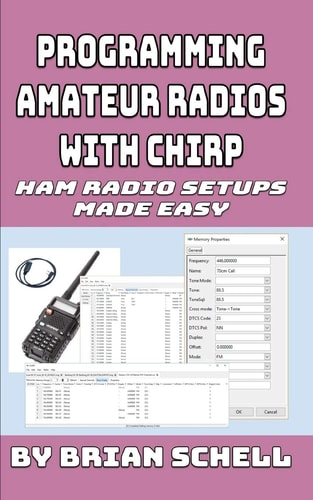
Programming Amateur Radios with CHIRP: Ham Radio Setups Made Easy
0
0
As an Amazon Associate and affiliate partner, Menrva Books earns from qualifying purchases. Learn more
Author Description
"Back in my day, radios came with a CW key and a frequency knob, and that was all we needed." -Every Old Ham Curmudgeon Ever OK, that's probably a slight exaggeration, but radios were a lot simpler in the "distant" past, when everything was station-to-station, and most communications were some flavor of HF. Nowadays, we have HF, VHF, UHF, digital modes, CW/SSB/AM/FM/MW, repeaters with offsets, repeaters with tones, User IDs, reflectors, talk groups, and who-knows-what coming down the road for next year. There are a lot of modes, tones, offsets, and little nit-picky details that have to go into our radios before we can even make a call. On the other hand, radios, especially handheld models, continue to get smaller, lighter, and generally have fewer physical buttons and controls. This is good in that it keeps costs down, adds to durability, and allows for waterproofing, but it doesn't make programming them any easier. Fortunately, we have computers to handle all the programming stuff for us. Just hook the radio up to the computer, enter in all your information, transfer the frequency and channel data into the radio, and you're good to go. Sounds simple, doesn't it? The problem is that radio manufacturers aren't necessarily good software designers. God forbid you try to program a radio on an Apple or Linux computer using manufacturer's software. None of the companies that make radios include software for these two very common operating systems. None. Even Windows users aren't in the clear. What happens when you try to use the software that came with your radio, when the radio was sold in 2007 and the software was made for Windows XP? Or maybe your radio came with a state-of-the-art serial port connector. That was great... back when all computers had serial ports; now, those are hard-to-find options or require an adaptor. And even though many ham operators enjoy tinkering with computers, there are many who still haven't embraced
Menrva's Summary
THE THESIS
This book addresses the complexities of programming modern amateur radios, particularly handheld models, which have become increasingly sophisticated yet less physically intuitive to operate. The author, Brian Schell, acknowledges the evolution of radio technology from simple analog devices to complex digital systems with numerous modes, tones, and user-defined settings. He highlights the challenges faced by amateur radio operators, especially when using manufacturer-provided software, which often lacks support for common operating systems like Apple or Linux, or is outdated for Windows users. The book aims to provide a practical solution by leveraging computer-based programming, specifically through the CHIRP software, to simplify the process of configuring these radios.
THE SCOPE MAP
- Explanation of the increasing complexity of modern amateur radios compared to older models.
- Discussion of the challenges in programming radios due to fewer physical controls and manufacturer software limitations.
- Focus on the use of computers and specific software (CHIRP) to overcome programming difficulties.
- Coverage of issues related to operating system compatibility (Windows, Apple, Linux) with radio software.
- Addressing problems with outdated software and hardware connectors (e.g., serial ports).
- Guidance for amateur radio operators who may not be highly tech-savvy.
- Practical steps and advice for setting up and programming ham radio equipment.
THE AUTHORITY PERSPECTIVE
The book is presented as a practical guide for amateur radio enthusiasts struggling with the programming of modern, often complex, handheld radios. The author's approach, focusing on the use of the CHIRP software, suggests a solution-oriented text aimed at simplifying a common pain point for radio operators. The description implies that the book will demystify the process, making it accessible even to those less comfortable with advanced computer operations, thereby enhancing the user experience with their radio equipment.
Page Count:
78
Publication Date:
2018-06-04
Publisher:
CreateSpace Independent Publishing Platform
ISBN-10:
1720767262
ISBN-13:
9781720767268
Science & Technology
Non-Fiction
Computers
Technology
How To
Community Tags
Similar Books