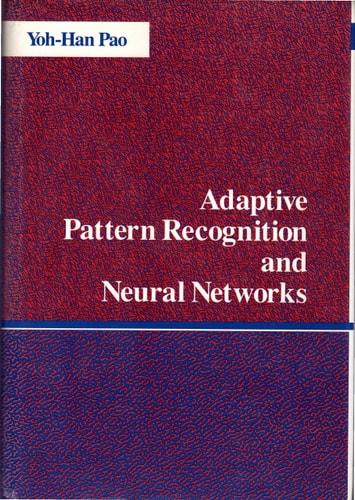
Adaptive Pattern Recognition and Neural Networks
0
0
As an Amazon Associate and affiliate partner, Menrva Books earns from qualifying purchases. Learn more
Author Description
This book both introduces and relates the basic concepts of pattern recognition and neural networks. The first part provides a much-needed, current, and coherent view of pattern recognition. The author points to recent developments in several disciplines — artificial intelligence, cognitive science, computer engineering, neurobiology, philosophy, and psychology — and shows how these developments have advanced both the science and the technology of pattern recognition — and thereby advanced our understanding of human perception and cognition and our design of intelligent systems.The second part of the book shows how adaptive pattern-recognition systems can be implemented using neural networks — that is, networks of elemental processors interconnected like their biological models. Neural-net implementations of pattern-recognition algorithms provide important, practical advantages by allowing iterative procedures to be implemented rapidly. But beyond those more immediate benefits, the author shows how a neural-net perspective on pattern information processing can stimulate us to be creative in visualizing new approaches.In discussing algorithms, the book focuses on the generic issues involved and the insights provided to date— for example, how to deal with structures within patterns, with degrees of belief,, with the concept of time, and with the possibility of using adaptive pattern recognition for discovering simple solutions to some truly difficult problems. Students, researchers, and practitioners in engineering, robotics, and computer, behavioural, and biological sciences will all appreciate the broad and interdisciplinary perspective of this timely introduction to pattern recognition and neural-net computing.
Menrva's Summary
THE THESIS
This book investigates the intersection of pattern recognition and neural network architectures to determine how adaptive systems can model human cognition and solve complex computational problems. Yoh-Han Pao, an expert in the field, synthesizes developments from neurobiology, computer engineering, and psychology to establish a coherent framework for intelligent system design. The text argues that neural networks provide both a practical implementation for iterative algorithms and a conceptual lens for visualizing novel approaches to information processing.
THE SCOPE MAP
What You Will Find
- A comprehensive overview of pattern recognition principles integrated with interdisciplinary research.
- Methodologies for implementing adaptive pattern-recognition systems using neural networks.
- Analysis of generic algorithmic issues including structural pattern analysis and the representation of time.
- Theoretical and practical applications for engineering, robotics, and the behavioral sciences.
THE AUTHORITY PERSPECTIVE
Experts and practitioners frequently cite this work as a foundational text for understanding the early integration of neural computing and pattern recognition. Readers often note the interdisciplinary breadth of the prose, which bridges the gap between biological modeling and practical engineering applications.
Page Count:
326
Publication Date:
1989-01-01
Publisher:
Addison-Wesley
ISBN-10:
0201125846
ISBN-13:
9780201125849
Robotics
Computer Science
Community Tags
Similar Books