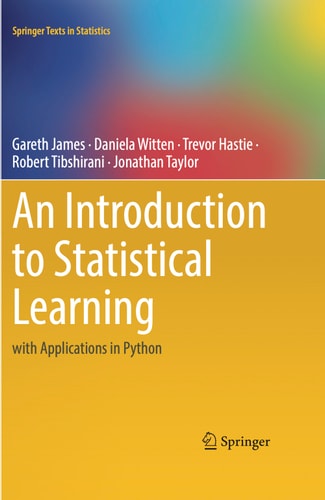
An Introduction to Statistical Learning with Applications in Python
0
0
As an Amazon Associate and affiliate partner, Menrva Books earns from qualifying purchases. Learn more
Author Description
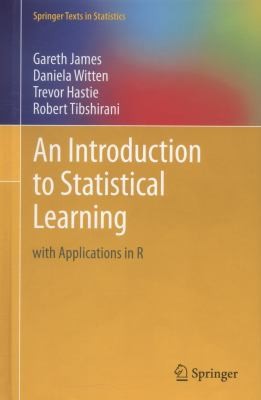
An Introduction to Statistical Learning provides an accessible overview of the field of statistical learning, an essential toolset for making sense of the vast and complex data sets that have emerged in fields ranging from biology to finance, marketing, and astrophysics in the past twenty years. This book presents some of the most important modeling and prediction techniques, along with relevant applications. Topics include linear regression, classification, resampling methods, shrinkage approaches, tree-based methods, support vector machines, clustering, deep learning, survival analysis, multiple testing, and more. Color graphics and real-world examples are used to illustrate the methods presented. This book is targeted at statisticians and non-statisticians alike, who wish to use cutting-edge statistical learning techniques to analyze their data. Four of the authors co-wrote An Introduction to Statistical Learning, With Applications in R(ISLR), which has become a mainstay of undergraduate and graduate classrooms worldwide, as well as an important reference book for data scientists. One of the keys to its success was that each chapter contains a tutorial on implementing the analyses and methods presented in the R scientific computing environment. However, in recent years Python has become a popular language for data science, and there has been increasing demand for a Python-based alternative to ISLR. Hence, this book (ISLP) covers the same materials as ISLR but with labs implemented in Python. These labs will be useful both for Python novices, as well as experienced users.
Menrva's Summary
THE THESIS
This book provides an accessible overview of statistical learning, a critical toolkit for interpreting complex data across diverse fields. It introduces essential modeling and prediction techniques, covering topics such as linear regression, classification, resampling methods, shrinkage approaches, tree-based methods, support vector machines, clustering, deep learning, survival analysis, and multiple testing. The text utilizes color graphics and real-world examples to illustrate these methods, aiming to equip both statisticians and non-statisticians with cutting-edge techniques for data analysis.
THE SCOPE MAP
- Coverage of key statistical learning methods including linear regression, classification, shrinkage approaches, tree-based methods, support vector machines, clustering, and deep learning.
- Implementation of these methods using Python, with practical labs designed for both novice and experienced Python users.
- Real-world examples and color graphics to illustrate statistical concepts and applications.
- A focus on making sense of vast and complex data sets relevant to fields like biology, finance, marketing, and astrophysics.
THE AUTHORITY PERSPECTIVE
This book is positioned as a Python-based counterpart to the highly successful 'An Introduction to Statistical Learning, With Applications in R' (ISLR). It aims to serve statisticians and non-statisticians alike who need to apply advanced statistical learning techniques to their data. The inclusion of Python labs is intended to meet the growing demand for Python-centric resources in data science education and practice.
Page Count:
607
Publication Date:
2023-07-01
Publisher:
Springer International Publishing
ISBN-10:
3031387465
ISBN-13:
9783031387463
Non-Fiction
Science
Data Science
Machine Learning
Python Programming
Statistics
Community Tags
Similar Books