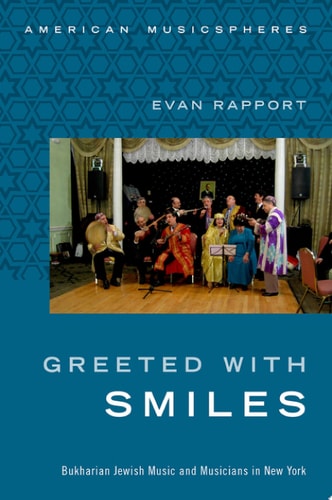
Greeted with Smiles: Bukharian Jewish Music and Musicians in New York
0
0
As an Amazon Associate and affiliate partner, Menrva Books earns from qualifying purchases. Learn more
Author Description
As the Soviet Union stood on the brink of collapse, thousands of Bukharian Jews left their homes from across the predominantly Muslim cities of Central Asia, to reestablish their lives in the United States, Israel and Europe. Today, about thirty thousand Bukharian Jews reside in New York City, settled into close-knit communities and existing as a quintessential American immigrant group. For Bukharian immigrants, music is an essential part of their communal self-definition, and musicians frequently act as cultural representatives for the group as a whole. Greeted with Smiles: Bukharian Jewish Music and Musicians in New York explores the circumstances facing new American immigrants, using the music of the Bukharian Jews to gain entrance into their community and their culture. Author Evan Rapport investigates the transformation of Bukharian identity through an examination of corresponding changes in its music, focusing on three of these distinct but overlapping repertoires - maqom (classical or "heavy" music), Jewish religious music and popular party (or "light") music. Drawing upon interviews, participant observation and music lessons, Rapport interprets the personal perspectives of musicians who serve as community leaders and representatives. By adapting strategies acquired as an ethno-religious minority among Central Asian Muslim neighbors, Bukharian musicians have adjusted their musical repertoire in their new American home. The result is the creation of a distinct Bukharian Jewish American identity-their musical activities are changing the city's cultural landscape while at the same time providing for an understanding of the cultural implications of Bukharian diaspora. Greeted with Smiles is sure to be an essential text for ethnomusicologists and scholars of Jewish and Central Asian music and culture, Jewish-Muslim interaction and diasporic communities.
Menrva's Summary
THE THESIS
This book investigates how the migration of Bukharian Jews to New York City has transformed their communal identity through the evolution of their musical traditions. Evan Rapport, an ethnomusicologist, utilizes extensive fieldwork, including participant observation and interviews with community musicians, to analyze how this diaspora group navigates its new American environment. The text argues that music serves as a primary vehicle for cultural preservation and adaptation, reflecting the group's historical experience as a minority population in Central Asia.
THE SCOPE MAP
What You Will Find
- Analysis of three distinct musical repertoires: maqom, Jewish religious music, and popular party music.
- Examination of the role of musicians as cultural representatives and community leaders.
- Documentation of the socio-cultural transition of Bukharian Jews from Central Asia to the United States.
Scope Limits
- The study focuses specifically on the Bukharian Jewish community in New York City and does not provide a comprehensive history of all Central Asian Jewish populations.
THE AUTHORITY PERSPECTIVE
Scholars in the fields of ethnomusicology and Jewish studies recognize this work as a detailed examination of diasporic cultural maintenance. Readers frequently note the academic rigor of the research and the author's ability to connect specific musical practices to broader sociological shifts within immigrant communities.
Page Count:
256
Publication Date:
2014-01-01
Publisher:
Oxford University Press
ISBN-10:
019022634X
ISBN-13:
9780190226343
Musicology
Jewish Studies
Asian Studies
Humanities
Cultural Anthropology
Community Tags
Other Editions(4)
Similar Books









Reader Comments
Share Your Thoughts
No comments yet. Be the first to share your thoughts!