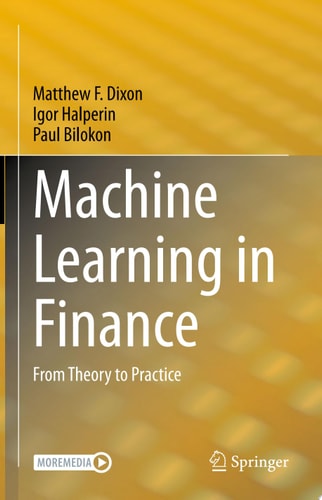
Machine Learning in Finance
0
0
As an Amazon Associate and affiliate partner, Menrva Books earns from qualifying purchases. Learn more
Author Description
This book introduces machine learning methods in finance. It presents a unified treatment of machine learning and various statistical and computational disciplines in quantitative finance, such as financial econometrics and discrete time stochastic control, with an emphasis on how theory and hypothesis tests inform the choice of algorithm for financial data modeling and decision making. With the trend towards increasing computational resources and larger datasets, machine learning has grown into an important skillset for the finance industry. This book is written for advanced graduate students and academics in financial econometrics, mathematical finance and applied statistics, in addition to quants and data scientists in the field of quantitative finance. Machine Learning in Finance: From Theory to Practice is divided into three parts, each part covering theory and applications. The first presents supervised learning for cross-sectional data from both a Bayesianand frequentist perspective. The more advanced material places a firm emphasis on neural networks, including deep learning, as well as Gaussian processes, with examples in investment management and derivative modeling. The second part presents supervised learning for time series data, arguably the most common data type used in finance with examples in trading, stochastic volatility and fixed income modeling. Finally, the third part presents reinforcement learning and its applications in trading, investment and wealth management. Python code examples are provided to support the readers' understanding of the methodologies and applications. The book also includes more than 80 mathematical and programming exercises, with worked solutions available to instructors. As a bridge to research in this emergent field, the final chapter presents the frontiers of machine learning in finance from a researcher's perspective, highlighting how many well-known concepts in statistical physics are likelyto emerge as important me
Menrva's Summary
THE THESIS
This book provides a comprehensive introduction to the application of machine learning methods within the field of finance. It bridges the gap between theoretical machine learning concepts and practical financial data modeling, offering a unified perspective that integrates statistical and computational disciplines. The authors emphasize how theoretical underpinnings and hypothesis testing guide the selection of algorithms for financial modeling and decision-making, addressing the growing importance of machine learning skills in the finance industry due to increasing computational power and data availability.
THE SCOPE MAP
- Introduction to machine learning methods in finance.
- Unified treatment of machine learning with financial econometrics and discrete time stochastic control.
- Emphasis on theory and hypothesis testing for algorithm selection in financial data modeling.
- Part 1: Supervised learning for cross-sectional data (Bayesian and frequentist perspectives), including neural networks, deep learning, and Gaussian processes with applications in investment management and derivative modeling.
- Part 2: Supervised learning for time series data, with applications in trading, stochastic volatility, and fixed income modeling.
- Part 3: Reinforcement learning and its applications in trading, investment, and wealth management.
- Python code examples to illustrate methodologies and applications.
- Over 80 mathematical and programming exercises with worked solutions for instructors.
THE AUTHORITY PERSPECTIVE
The book is targeted at advanced graduate students and academics in financial econometrics, mathematical finance, and applied statistics, as well as quants and data scientists in quantitative finance. The structure, divided into three parts covering supervised learning for cross-sectional and time series data, and reinforcement learning, suggests a thorough exploration of the subject matter. The inclusion of Python code examples and numerous exercises indicates a practical, hands-on approach to learning. The final chapter's focus on research frontiers points to its utility for those looking to engage with the emergent field of machine learning in finance.
Page Count:
548
Publication Date:
2020-07-01
Publisher:
Springer Nature
ISBN-10:
3030410684
ISBN-13:
9783030410681
Science
Business
Non-Fiction
Science & Technology
Data Science
Trading
Finance
Machine Learning
Wealth Management
Econometrics
Community Tags
Similar Books




Reader Comments
Share Your Thoughts
No comments yet. Be the first to share your thoughts!