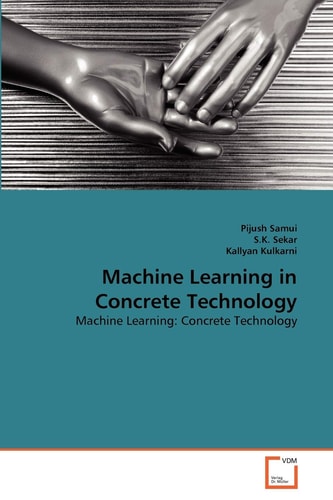
Machine Learning in Concrete Technology: Machine Learning: Concrete Technology
0
0
As an Amazon Associate and affiliate partner, Menrva Books earns from qualifying purchases. Learn more
Author Description
The determination of Elastic Modulus (E) of normal strength concrete is an important task in civil engineering for infrastructure development. Experimental methods for determination of E value of normal strength concrete are complicated and time consuming. This article employs an Artificial Intelligence (AI) technique for prediction of E value of normal strength concrete. The results are compared with a widely used Artificial Neural Network (ANN), Support Vector Machine (SVM) model and empirical equation from the different buildings codes. Equations have been also developed for determination of E value of normal strength concrete based on the AI. The developed AI model also gives error bar of predicted E value. The predicted error bar can be used to determine model uncertainty. This study shows that the developed AI is a robust model for prediction of E value of normal strength concrete.
Menrva's Summary
THE THESIS
This study investigates the application of Artificial Intelligence (AI) techniques for predicting the Elastic Modulus (E) of normal strength concrete. The determination of concrete's Elastic Modulus is crucial for civil engineering infrastructure development, but traditional experimental methods are complex and time-consuming. This research employs an AI technique to predict the E value, comparing its performance against Artificial Neural Network (ANN), Support Vector Machine (SVM) models, and empirical equations from building codes. The developed AI model also provides an error bar for predicted E values, which can be used to assess model uncertainty, demonstrating its robustness for this prediction task.
THE SCOPE MAP
- Application of Artificial Intelligence (AI) for predicting the Elastic Modulus (E) of normal strength concrete.
- Comparison of AI model performance with Artificial Neural Network (ANN), Support Vector Machine (SVM), and empirical equations from building codes.
- Development of new equations for determining the E value of normal strength concrete based on AI.
- Inclusion of error bars for predicted E values to quantify model uncertainty.
- Analysis of the AI model's robustness for predicting concrete properties.
THE AUTHORITY PERSPECTIVE
This work presents a focused application of AI in civil engineering, specifically for predicting the Elastic Modulus of concrete. The methodology involves comparing a novel AI approach against established techniques like ANN and SVM, alongside empirical equations. The inclusion of error bars for predictions is a notable feature, offering a measure of model uncertainty. The study concludes that the developed AI model is a robust tool for this specific engineering prediction task.
Page Count:
84
Publication Date:
2011-05-11
Publisher:
VDM Verlag Dr. Müller
ISBN-10:
3639356845
ISBN-13:
9783639356847
Science
Non-Fiction
Science & Technology
Machine Learning
Concrete Technology
Civil Engineering
Community Tags
Similar Books