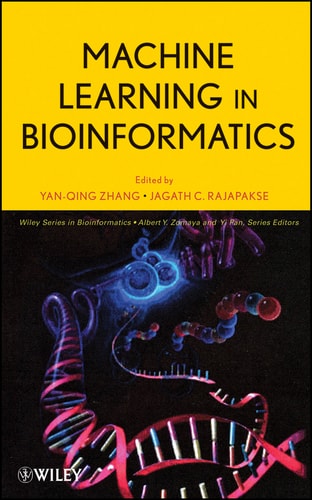
Machine Learning in Bioinformatics
0
0
As an Amazon Associate and affiliate partner, Menrva Books earns from qualifying purchases. Learn more
Author Description
An Introduction To Machine Learning Methods And Their Applications To Problems In Bioinformatics Machine Learning Techniques Are Increasingly Being Used To Address Problems In Computational Biology And Bioinformatics. Novel Computational Techniques To Analyze High Throughput Data In The Form Of Sequences, Gene And Protein Expressions, Pathways, And Images Are Becoming Vital For Understanding Diseases And Future Drug Discovery. Machine Learning Techniques Such As Markov Models, Support Vector Machines, Neural Networks, And Graphical Models Have Been Successful In Analyzing Life Science Data B Machine Learning In Bioinformatics; Contents; Foreword; Preface; Contributors; 1 Feature Selection For Genomic And Proteomic Data Mining; 2 Comparing And Visualizing Gene Selection And Classification Methods For Microarray Data; 3 Adaptive Kernel Classifiers Via Matrix Decomposition Updating For Biological Data Analysis; 4 Bootstrapping Consistency Method For Optimal Gene Selection From Microarray Gene Expression Data For Classification Problems; 5 Fuzzy Gene Mining: A Fuzzy-based Framework For Cancer Microarray Data Analysis; 6 Feature Selection For Ensemble Learning And Its Application 7 Sequence-based Prediction Of Residue-level Properties In Proteins8 Consensus Approaches To Protein Structure Prediction; 9 Kernel Methods In Protein Structure Prediction; 10 Evolutionary Granular Kernel Trees For Protein Subcellular Location Prediction; 11 Probabilistic Models For Long-range Features In Biosequences; 12 Neighborhood Profile Search For Motif Refinement; 13 Markov/neural Model For Eukaryotic Promoter Recognition; 14 Eukaryotic Promoter Detection Based On Word And Sequence Feature Selection And Combination 15 Feature Characterization And Testing Of Bidirectional Promoters In The Human Genome-significance And Applications In Human Genome Research16 Supervised Learning Methods For Microrna Studies; 17 Machine Learning For Computational Haplotype Analysis; 18 Machine Learning Applic
Menrva's Summary
THE THESIS
This book introduces machine learning methods and their applications to problems in bioinformatics. It addresses the growing need for computational techniques to analyze high-throughput data in areas such as sequences, gene and protein expressions, pathways, and images, which are vital for understanding diseases and drug discovery. The text covers a range of machine learning techniques, including Markov models, support vector machines, neural networks, and graphical models, demonstrating their successful application to life science data.
THE SCOPE MAP
- Feature Selection for Genomic and Proteomic Data Mining
- Comparing and Visualizing Gene Selection and Classification Methods for Microarray Data
- Adaptive Kernel Classifiers via Matrix Decomposition Updating for Biological Data Analysis
- Fuzzy Gene Mining: A Fuzzy-based Framework for Cancer Microarray Data Analysis
- Sequence-based Prediction of Residue-level Properties in Proteins
- Consensus Approaches to Protein Structure Prediction
- Probabilistic Models for Long-range Features in Biosequences
- Markov/neural Model for Eukaryotic Promoter Recognition
THE AUTHORITY PERSPECTIVE
The book is structured as a collection of chapters contributed by various experts, indicating a comprehensive overview of machine learning applications in bioinformatics. The detailed table of contents suggests a focus on specific techniques and their practical uses in analyzing biological data, from gene expression to protein structure. The breadth of topics covered implies that the book serves as a valuable resource for researchers and students seeking to apply advanced computational methods to biological problems. Its detailed chapter titles point to a technical and data-driven approach to understanding complex biological systems.
Page Count:
0
Publication Date:
1900-01-01
Publisher:
Wiley
ISBN-10:
1282030701
ISBN-13:
9781282030701
Science
Non-Fiction
Bioinformatics
Genomics
Machine Learning
Data Mining
Proteomics
Community Tags
Similar Books