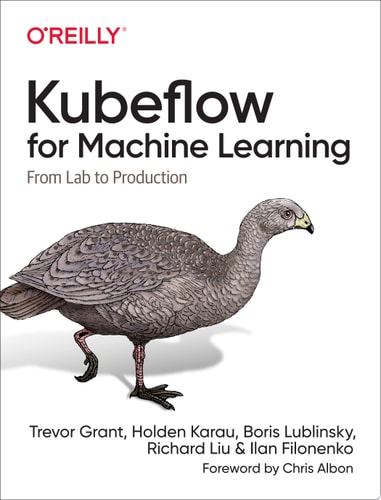
Kubeflow for Machine Learning
0
0
As an Amazon Associate and affiliate partner, Menrva Books earns from qualifying purchases. Learn more
Author Description
If you're training a machine learning model but aren't sure how to put it into production, this book will get you there. Kubeflow provides a collection of cloud native tools for different stages of a model's lifecycle, from data exploration, feature preparation, and model training to model serving. This guide helps data scientists build production-grade machine learning implementations with Kubeflow and shows data engineers how to make models scalable and reliable. Using examples throughout the book, authors Holden Karau, Trevor Grant, Ilan Filonenko, Richard Liu, and Boris Lublinsky explain how to use Kubeflow to train and serve your machine learning models on top of Kubernetes in the cloud or in a development environment on-premises. Understand Kubeflow's design, core components, and the problems it solves Understand the differences between Kubeflow on different cluster types Train models using Kubeflow with popular tools including Scikit-learn, TensorFlow, and Apache Spark Keep your model up to date with Kubeflow Pipelines Understand how to capture model training metadata Explore how to extend Kubeflow with additional open source tools Use hyperparameter tuning for training Learn how to serve your model in production
Menrva's Summary
THE THESIS
This book addresses the challenge of deploying machine learning models into production environments. It guides data scientists and data engineers in leveraging Kubeflow, a suite of cloud-native tools, to manage the entire lifecycle of a machine learning model, from initial data exploration and preparation to training, serving, and ongoing updates. The authors demonstrate how to use Kubeflow with Kubernetes for scalable and reliable model implementations, whether in the cloud or on-premises.
THE SCOPE MAP
- Understanding Kubeflow's architecture, core components, and problem-solving capabilities.
- Distinguishing between Kubeflow deployments on various cluster types.
- Training machine learning models using Kubeflow with popular frameworks like Scikit-learn, TensorFlow, and Apache Spark.
- Managing model updates and continuous integration with Kubeflow Pipelines.
- Capturing and analyzing model training metadata.
- Extending Kubeflow's functionality with additional open-source tools.
- Implementing hyperparameter tuning for model optimization and serving models in production.
THE AUTHORITY PERSPECTIVE
The book is positioned as a practical guide for data scientists and engineers seeking to operationalize machine learning models. It focuses on the practical application of Kubeflow, a platform designed for managing the machine learning lifecycle on Kubernetes. The content emphasizes hands-on examples and covers key aspects from model training to deployment and maintenance, suggesting it is aimed at professionals needing to build production-grade ML systems.
Page Count:
264
Publication Date:
2020-10-13
Publisher:
"O'Reilly Media, Inc."
ISBN-10:
1492050091
ISBN-13:
9781492050094
Science & Technology
Non-Fiction
Data Science
Machine Learning
Community Tags
Similar Books