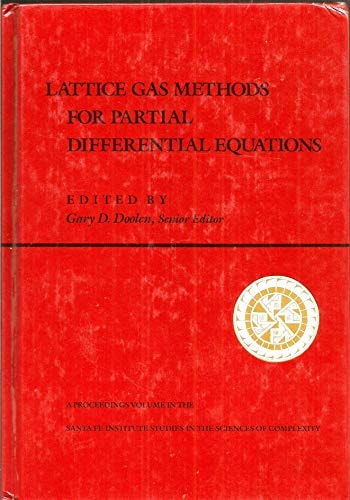
Lattice Gas Methods for Partial Differential Equations
0
0
As an Amazon Associate and affiliate partner, Menrva Books earns from qualifying purchases. Learn more
Author Description
Although the idea of using discrete methods for modeling partial differential equations occurred very early, the actual statement that cellular automata techniques can approximate the solutions of hydrodynamic partial differential equations was first discovered by Frisch, Hasslacher, and Pomeau. Their description of the derivation, which assumes the validity of the Boltzmann equation, appeared in the Physical Review Letters in April 1986. It is the intent of this book to provide some overview of the directions that lattice gas research has taken from 1986 to early 1989.
Menrva's Summary
THE THESIS
This volume investigates the efficacy of lattice gas cellular automata as a computational method for approximating solutions to hydrodynamic partial differential equations. The authors, a collective of researchers associated with the Santa Fe Institute, compile a series of papers that examine the theoretical foundations and practical applications of discrete modeling techniques. By building upon the seminal 1986 work of Frisch, Hasslacher, and Pomeau, the text provides a rigorous examination of how microscopic discrete rules can recover macroscopic fluid behavior governed by the Navier-Stokes equations.
THE SCOPE MAP
What You Will Find
- Theoretical derivation of lattice gas models from the Boltzmann equation
- Analysis of hydrodynamic limits in discrete cellular automata systems
- Comparative studies between lattice gas methods and traditional numerical solvers
- Research developments and computational advancements in the field from 1986 to 1989
THE AUTHORITY PERSPECTIVE
Experts recognize this volume as a foundational collection for understanding the early development of lattice gas methods in computational physics. Readers frequently note the technical density of the prose, which assumes a strong background in fluid dynamics and statistical mechanics.
Page Count:
554
Publication Date:
1990-01-21
Publisher:
Westview Press
ISBN-10:
0201156792
ISBN-13:
9780201156799
Science
Lattice Theory
Computer Science
Physics
Mathematics
Community Tags
Similar Books