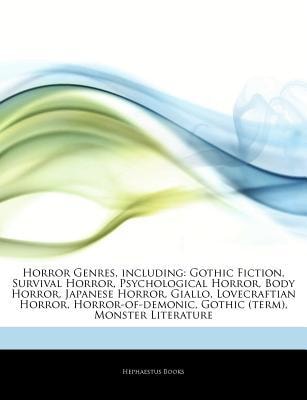
Horror Genres
0
0
As an Amazon Associate and affiliate partner, Menrva Books earns from qualifying purchases. Learn more
Author Description
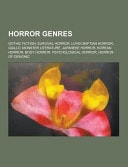
Please note that the content of this book primarily consists of articles available from Wikipedia or other free sources online. Pages: 27. Chapters: Gothic fiction, Survival horror, Lovecraftian horror, Giallo, Monster literature, Japanese horror, Korean horror, Body horror, Psychological horror, Horror-of-demonic. Excerpt: Gothic fiction, sometimes referred to as Gothic horror, is a genre of literature that combines elements of both horror and romance. As a genre, it is generally believed to have been invented by the English author Horace Walpole, with his 1764 novel The Castle of Otranto. The effect of Gothic fiction feeds on a pleasing sort of terror, an extension of Romantic literary pleasures that were relatively new at the time of Walpole's novel. Melodrama and parody (including self-parody) were other long-standing features of the Gothic initiated by Walpole. Gothic literature is intimately associated with the Gothic Revival architecture of the same era. In a way similar to the Gothic revivalists' rejection of the clarity and rationalism of the neoclassical style of the Enlightened Establishment, the literary Gothic embodies an appreciation of the joys of extreme emotion, the thrills of fearfulness and awe inherent in the sublime, and a quest for atmosphere. The ruins of Gothic buildings gave rise to multiple linked emotions by representing the inevitable decay and collapse of human creations-thus the urge to add fake ruins as eyecatchers in English landscape parks. English Gothic writers often associated medieval buildings with what they saw as a dark and terrifying period, characterized by harsh laws enforced by torture, and with mysterious, fantastic, and superstitious rituals. In literature such Anti-Catholicism had a European dimension featuring Roman Catholic excesses such as the Inquisition (in southern European countries such as Italy and Spain). Prominent features of Gothic fiction include terror (both psychological and physical), mystery, the...
Menrva's Summary
THE PULSE
A chilling compendium of horror subgenres explores the darkest corners of human fear. This book delves into the distinct characteristics and historical development of various horror classifications, from the atmospheric dread of Gothic fiction and the visceral terror of survival horror to the cosmic unease of Lovecraftian horror and the stylized violence of Giallo. It examines the evolution of monster literature, the unique contributions of Japanese and Korean horror, and the disturbing explorations of body horror and psychological horror. The compilation aims to provide a comprehensive overview of the diverse ways horror manifests in literature and media.
INSIDE THE PAGES
- Detailed examination of Gothic fiction, including its origins with Horace Walpole and its characteristic blend of horror and romance.
- Exploration of Survival Horror, focusing on its emphasis on resource management and vulnerability.
- Analysis of Lovecraftian Horror, highlighting cosmic dread and the insignificance of humanity.
- Discussion of Giallo, its origins in Italian cinema and literature, and its focus on mystery and stylized violence.
- Overview of Monster Literature, tracing the evolution of monstrous figures in storytelling.
- Features on Japanese Horror (J-horror) and Korean Horror, noting their unique cultural influences and thematic concerns.
- In-depth look at Body Horror, exploring its focus on the violation and degradation of the human form.
- Analysis of Psychological Horror, emphasizing mental and emotional states as the primary source of terror.
THE COLLECTIVE ECHO
This compilation draws directly from Wikipedia and other online sources, presenting a factual overview of various horror subgenres. The content is structured to inform readers about the defining elements, historical context, and key examples within each category. The excerpt on Gothic fiction provides a solid foundation, illustrating the genre's roots and its connection to architectural and emotional sensibilities. The breadth of topics covered suggests a resource for those seeking to understand the diverse landscape of horror literature and its thematic preoccupations.
Page Count:
28
Publication Date:
2013-09-01
Publisher:
General Books
ISBN-10:
1230610529
ISBN-13:
9781230610528
Fiction
Horror
Psychological Horror
Gothic
Community Tags
Similar Books