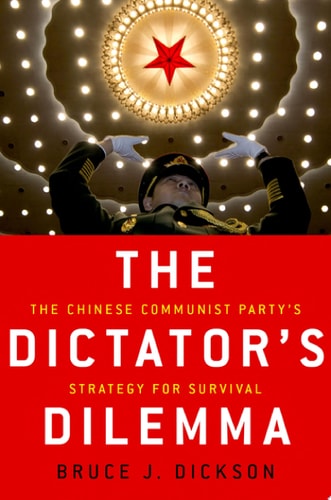
The Dictator's Dilemma: The Chinese Communist Party's Strategy for Survival
0
0
As an Amazon Associate and affiliate partner, Menrva Books earns from qualifying purchases. Learn more
Author Description
Many observers predicted the collapse of the Chinese Communist Party following the Tiananmen Square crackdown in 1989, and again following the serial collapse of communist regimes behind the Iron Curtain. Their prediction, however, never proved true. Despite minor setbacks, China has experienced explosive economic growth and relative political stability ever since 1989. In The Dictator's Dilemma, eminent China scholar Bruce Dickson provides a comprehensive explanation for regime's continued survival and prosperity. Dickson contends that the popular media narrative of the party's impending implosion ignores some basic facts. The regime's policies may generate resentment and protest, but the CCP still enjoys a surprisingly high level of popular support. Nor is the party is not cut off from the people it governs. It consults with a wide range of specialists, stakeholders, and members of the general public in a selective yet extensive manner. Further, it tolerates and even encourages a growing and diverse civil society, even while restricting access to it. Today, the majority of Chinese people see the regime as increasingly democratic even though it does not allow political competition and its leaders are not accountable to the electorate. In short, while the Chinese people may prefer change, they prefer that it occurs within the existing political framework. In reaching this conclusion, Dickson draws upon original public opinion surveys, interviews, and published materials to explain why there is so much popular support for the regime. This basic stability is a familiar story to China specialists, but not to those whose knowledge of contemporary China is limited to the popular media. The Dictator's Dilemma, an engaging synthesis of how the CCP rules and its future prospects, will enlighten both audiences, and will be essential for anyone interested in understanding China's increasing importance in world politics.
Menrva's Summary
THE THESIS
This book investigates the mechanisms that have allowed the Chinese Communist Party to maintain political stability and popular support despite widespread predictions of its collapse. Bruce Dickson, a professor of political science and international affairs, utilizes a combination of original public opinion surveys, interviews, and academic literature to challenge the narrative of inevitable regime failure. He argues that the CCP's survival is rooted in its ability to adapt, consult with stakeholders, and manage a controlled civil society while maintaining a framework that the public perceives as legitimate.
THE SCOPE MAP
What You Will Find
- Analysis of the CCP's adaptive governance strategies since 1989.
- Examination of public opinion data regarding regime legitimacy and political satisfaction.
- Assessment of the party's relationship with civil society and interest groups.
Scope Limits
- The text does not provide a predictive model for the exact timing of future political shifts.
- It does not focus on the internal factional power struggles within the party leadership.
THE AUTHORITY PERSPECTIVE
Experts in the field of China studies recognize this work as a significant contribution to understanding the resilience of authoritarian regimes. Readers frequently note the clarity of the prose, which makes complex political science concepts accessible to both academic and general audiences.
Page Count:
366
Publication Date:
2016-01-01
Publisher:
Oxford University Press
ISBN-10:
0190228571
ISBN-13:
9780190228576
History
International relations
Sociology
Government
China Studies
Community Tags
Similar Books