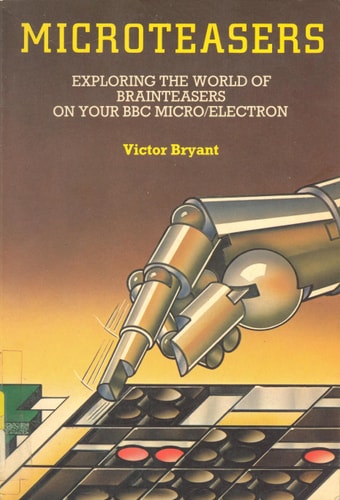
Microteasers: Exploring the World of Brainteasers on Your BBC Micro/Electron
0
0
As an Amazon Associate and affiliate partner, Menrva Books earns from qualifying purchases. Learn more
Author Description
Using a micro to solve a brainteaser? That's cheating! Hardly. You can't just type in a teaser and expect the answer to pop up. In fact, using a micro may take more through than working out the answer with pencil and paper. Why bother then? Well, to write a successful puzzle-solving program you need a clear insight into how the problem works. There is no place for guesswork - it's logic and reasoning that count. However, once your program is working you can use it to explore other puzzles, and device brainteasers of your own. Victor Bryant is an experienced compiler of brainteasers. In *Microteasers: Exploring the world of brainteasers on your BBC Micro/Electron*, he has assembled over 40 popular puzzles, some of which have already baffled readers of the *Sunday Times* and the *New Scientist*. Try and solve them for yourself but don't worry if you end up perplexed, the author is always at hand to explain what's going on, and how you can use your BBC Micro or Electron to help you reach an answer. Primes, patterns, palindromes and Pythagoras are among the many areas that the author explores and explains. For programmers and puzzle addicts alike, *Microteasers: Exploring the world of brainteasers on your BBC Micro/Electron* will provide many hours of fun and mental stimulation.
Menrva's Summary
THE THESIS
This book investigates the intersection of computational logic and recreational mathematics by demonstrating how to program the BBC Micro and Electron to solve complex brainteasers. Author Victor Bryant, an experienced puzzle compiler, argues that the process of coding a solution requires a deeper analytical understanding of a problem than manual calculation, ultimately transforming the computer into a tool for exploration and original puzzle design.
THE SCOPE MAP
What You Will Find
- Over 40 curated brainteasers previously featured in publications like the Sunday Times and New Scientist.
- Programming methodologies for implementing logical reasoning and algorithmic problem-solving on 8-bit hardware.
- Mathematical explorations covering prime numbers, numerical patterns, palindromes, and geometric principles.
- Step-by-step guidance on translating abstract puzzle constraints into functional code.
THE AUTHORITY PERSPECTIVE
This text is recognized as a niche resource for enthusiasts of 1980s-era British microcomputing and recreational mathematics. Readers frequently note that while the hardware-specific code is dated, the logical frameworks provided remain useful for understanding the fundamentals of algorithmic puzzle design.
Page Count:
113
Publication Date:
1984-01-01
Publisher:
Addison-Wesley
ISBN-10:
020118088X
ISBN-13:
9780201180886
Puzzles
Mathematics
computing
Programming
Microcomputers
Reference
Community Tags
Similar Books