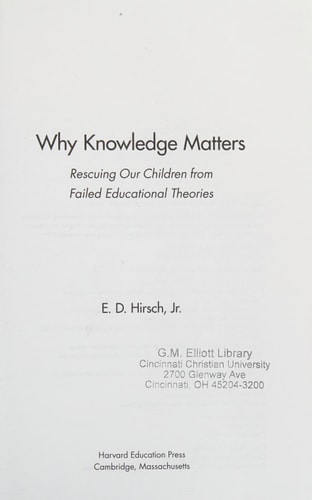
Why Knowledge Matters: Rescuing Our Children from Failed Educational Theories
0
0
As an Amazon Associate and affiliate partner, Menrva Books earns from qualifying purchases. Learn more
Author Description
In Why Knowledge Matters, E. D. Hirsch, Jr., presents evidence from cognitive science, sociology, and education history to further the argument for a knowledge-based elementary curriculum. Influential scholar Hirsch, author of The Knowledge Deficit, asserts that a carefully planned curriculum that imparts communal knowledge is essential in achieving one of the most fundamental aims and objectives of education: preparing students for lifelong success. Hirsch examines historical and contemporary evidence from the United States and other nations, including France, and affirms that a knowledge-based approach has improved both achievement and equity in schools where it has been instituted. In contrast, educational change of the past several decades in the United States has endorsed a skills-based approach, founded on, Hirsch points out, many incorrect assumptions about child development and how children learn. He recommends new policies that are better aligned with our current understanding of neuroscience, developmental psychology, and social science. The book focuses on six persistent problems that merit the attention of contemporary education reform: the over-testing of students in the name of educational accountability; the scapegoating of teachers; the fadeout of preschool gains; the narrowing of the curriculum to crowd out history, geography, science, literature, and the arts; the achievement gap between demographic groups; and the reliance on standards, such as the Common Core State Standards, that are not linked to a rigorous curriculum. Why Knowledge Matters makes a clear case for educational innovation and introduces a new generation of American educators to Hirsch's astute and passionate analysis.
Menrva's Summary
THE THESIS
Why Knowledge Matters argues for a return to a knowledge-based elementary curriculum, challenging prevailing educational theories. E. D. Hirsch, Jr., a renowned scholar, presents a compelling case, drawing on evidence from cognitive science, sociology, and educational history, to advocate for a structured curriculum that imparts essential communal knowledge. He contends that this approach is fundamental to preparing students for lifelong success and has historically proven to improve both academic achievement and equity in schools. Hirsch critiques the current skills-based approach prevalent in the United States, identifying its reliance on flawed assumptions about child development and learning, and proposes policy changes informed by contemporary neuroscience, developmental psychology, and social science.
THE SCOPE MAP
- Evidence from cognitive science, sociology, and education history supporting a knowledge-based curriculum.
- Analysis of historical and contemporary educational systems in the United States and other nations, such as France.
- Critique of the skills-based educational approach and its underlying assumptions about child development.
- Recommendations for new educational policies aligned with current understandings of neuroscience and psychology.
- Discussion of six persistent problems in contemporary education reform: over-testing, scapegoating teachers, preschool fadeout, curriculum narrowing, the achievement gap, and flawed standards.
- A defense of communal knowledge as essential for educational equity and student success.
THE AUTHORITY PERSPECTIVE
This book is regarded as a significant contribution to the discourse on educational reform, particularly for its robust defense of a knowledge-based curriculum. Hirsch's work is noted for its synthesis of interdisciplinary evidence and its direct challenge to prevailing educational philosophies in the United States. The book is expected to inform contemporary debates on curriculum development, assessment, and educational policy, offering a historical and scientific perspective on achieving both academic rigor and equity in schools.
Page Count:
270
Publication Date:
2016-01-01
Publisher:
Harvard Education Press
ISBN-10:
1612509525
ISBN-13:
9781612509525
Politics
Non-Fiction
Sociology
Educational Policy
Education
Community Tags
Similar Books