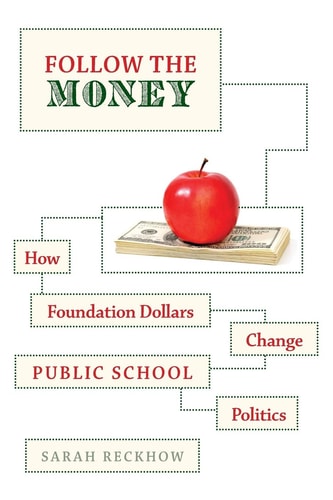
Follow the Money: How Foundation Dollars Change Public School Politics
0
0
As an Amazon Associate and affiliate partner, Menrva Books earns from qualifying purchases. Learn more
Author Description
Some of the nation's wealthiest philanthropic organizations, including the Bill and Melinda Gates Foundation, the Walton Family Foundation, and the Broad Foundation, have invested hundreds of millions of dollars in education reform. With vast wealth and a political agenda, these foundations have helped to reshape the reform landscape in urban education. In Follow the Money, Sarah Reckhow shows where and how foundation investment in education is occurring and provides a penetrating analysis of the effects of these investments in the two largest urban districts in the United States: New York City and Los Angeles.In New York City, centralized political control and the use of private resources have enabled rapid implementation of reform proposals. Yet this potent combination of top-down authority and outside funding also poses serious questions about transparency, responsiveness, and democratic accountability in New York. Furthermore, the sustainability of reform policies is closely linked to the political fortunes of the current mayor and his chosen school leader. While the media has highlighted the efforts of forceful reformers and dominating leaders such as Joel Klein in New York City and Michelle Rhee in Washington, D.C., a slower, but possibly more transformative, set of reforms have been taking place in Los Angeles. These reforms were also funded and shaped by major foundations, but they work from the bottom up, through charter school operators managing networks of schools. This strategy has built grassroots political momentum and demand for reform in Los Angeles that is unmatched in New York City and other districts with mayoral control. Reckhow's study of Los Angeles's education system shows how democratically responsive urban school reform could occur-pairing foundation investment with broad grassroots involvement.Bringing a sharp analytical eye and a wealth of evidence to one of the most politicized issues of our day, Follow the Money will reshape our thinking
Menrva's Summary
THE THESIS
This book investigates how the influx of private philanthropic capital from major foundations influences the political landscape and policy outcomes of public school systems in the United States. Sarah Reckhow, a political scientist, utilizes a comparative framework to examine the intersection of private wealth and public education governance. By analyzing the distinct reform strategies employed in New York City and Los Angeles, the author argues that the structure of local political authority determines whether foundation-funded initiatives result in top-down mandates or grassroots-driven change.
THE SCOPE MAP
What You Will Find
- Comparative analysis of education reform in New York City and Los Angeles
- Examination of the influence of the Bill and Melinda Gates, Walton Family, and Broad foundations
- Assessment of the relationship between mayoral control and private funding
- Analysis of charter school network expansion as a political strategy
Scope Limits
- Does not provide an exhaustive survey of every urban school district in the United States
- Focuses primarily on the political and structural impacts rather than individual student academic outcomes
THE AUTHORITY PERSPECTIVE
Experts in education policy and political science recognize this work as a significant contribution to the study of private influence in public governance. Readers frequently note the academic rigor of the comparative analysis and the clarity with which the author navigates complex political systems.
Page Count:
236
Publication Date:
2015-01-01
Publisher:
Oxford University Press
ISBN-10:
0190227346
ISBN-13:
9780190227340
Philanthropy
Urban Studies
United States
Public Administration
American Politics
Education finance
Education Policy
Community Tags
Similar Books