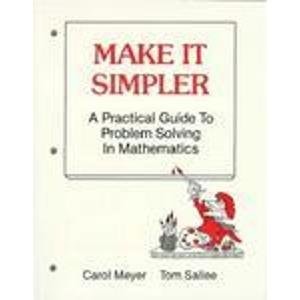
Make It Simpler: A Practical Guide to Problem Solving in Mathematics
0
0
As an Amazon Associate and affiliate partner, Menrva Books earns from qualifying purchases. Learn more
Author Description
The authors state that "the approach you will find in this book is based on the following 1. The developmental theorists (Plaget, Burner, et al) are essentially correct in their understanding of how minds mature as children grow. 2. It follows from these theorists that the ages ten to fourteen are crucial in the development of adult thinking styles. 3. Children can be taught to reason well. What is needed is an effective way to teach a whole classroom full of children to reason well. 4. Learning requires interaction with someone else. 5. Learning a relatively few reasoning techniques will enable an individual to deal effectively with most types of problems. 6. The major barrier to effective problem solving is psychological rather than intellectual. From these beliefs, the authors developed a two-pronged approach for children of the appropriate ages. First, almost all activities must take place in a group setting. Second, the students are taught a sequence of necessary understanding a problem, learning general strategies and selecting an appropriate strategy. Within these groups the students learn the basics of solving problems, beginning with the idea that problem solving is not such a difficult skill after all. A wide variety of activities are used beginning with open questions and gradually moving toward questions which have a definite solution. Many of these activities are in the form of games to increase student interaction and hypothesis testing within the group."
Menrva's Summary
THE THESIS
This book investigates how to effectively teach mathematical reasoning and problem-solving skills to students between the ages of ten and fourteen. Authors Carol Meyer and Tom Sallee argue that the primary obstacles to mathematical proficiency are psychological rather than intellectual, and that students can be trained to reason effectively through structured group interaction and the application of specific, repeatable strategies.
THE SCOPE MAP
What You Will Find
- A pedagogical framework based on the developmental theories of Piaget and Bruner.
- A two-pronged instructional approach emphasizing group-based learning and collaborative hypothesis testing.
- A structured sequence for problem solving: understanding the problem, identifying strategies, and selecting the appropriate method.
- A collection of classroom activities and games designed to transition students from open-ended inquiry to definitive problem solving.
THE AUTHORITY PERSPECTIVE
Educators and mathematics specialists frequently cite this work as a practical resource for middle-school classroom management and curriculum development. Experts highlight the text for its focus on the social dimensions of learning and its accessible approach to teaching logical reasoning to young adolescents.
Page Count:
282
Publication Date:
1983-01-01
Publisher:
Addison-wesley
ISBN-10:
0201200368
ISBN-13:
9780201200362
Mathematics
Education
Teaching Methods
Pedagogy
Community Tags
Similar Books