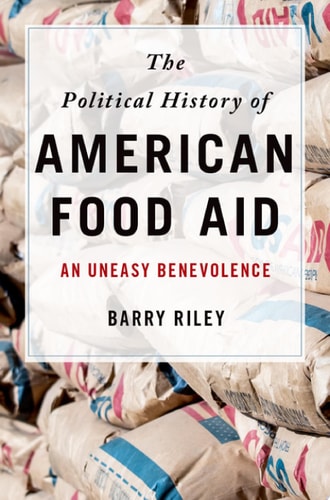
The Political History of American Food Aid: An Uneasy Benevolence
0
0
As an Amazon Associate and affiliate partner, Menrva Books earns from qualifying purchases. Learn more
Author Description
American food aid to foreigners long has been the most visible-and most popular-means of providing humanitarian aid to millions of hungry people confronted by war, terrorism and natural cataclysms and the resulting threat-often the reality-of famine and death. The book investigates the little-known, not-well-understood and often highly-contentious political processes which have converted American agricultural production into tools of U.S. government policy.In The Political History of American Food Aid, Barry Riley explores the influences of humanitarian, domestic agricultural policy, foreign policy, and national security goals that have created the uneasy relationship between benevolent instincts and the realpolitik of national interests. He traces how food aid has been used from the earliest days of the republic in widely differing circumstances: as a response to hunger, a weapon to confront the expansion of bolshevism after World War I and communism after World War II, a method for balancing disputes between Israel and Egypt, a channel for disposing of food surpluses, a signal of support to friendly governments, and a means for securing the votes of farming constituents or the political support of agriculture sector lobbyists, commodity traders, transporters and shippers.Riley's broad sweep provides a profound understanding of the complex factors influencing American food aid policy and a foundation for examining its historical relationship with relief, economic development, food security and its possible future in a world confronting the effects of global climate change.
Menrva's Summary
THE THESIS
This book investigates the complex and often contentious political processes that have transformed American agricultural production into a strategic instrument of U.S. government policy. Barry Riley, drawing on his extensive background in international development and policy, examines the intersection of humanitarian intent and national interest. He argues that American food aid has historically functioned as a dual-purpose mechanism, serving both as a response to global hunger and as a tool for achieving foreign policy, national security, and domestic economic objectives.
THE SCOPE MAP
What You Will Find
- Historical analysis of U.S. food aid from the early republic through the modern era.
- Examination of the influence of agricultural lobbyists, commodity traders, and shipping interests on policy formation.
- Case studies illustrating the use of food aid as a geopolitical weapon against communism and as a diplomatic tool in the Middle East.
Scope Limits
- The text focuses primarily on the political and economic motivations behind U.S. policy rather than detailed field-level accounts of aid distribution logistics.
THE AUTHORITY PERSPECTIVE
Experts recognize this work as a comprehensive historical account of the intersection between American agricultural interests and foreign policy. Readers frequently note the academic rigor and the clarity with which Riley navigates the competing motivations behind humanitarian aid programs.
Page Count:
592
Publication Date:
2017-09-22
Publisher:
Oxford University Press
ISBN-10:
0190228873
ISBN-13:
9780190228873
History
Agriculture
United States
Public Policy
Food Relief
International relations
Community Tags
Similar Books