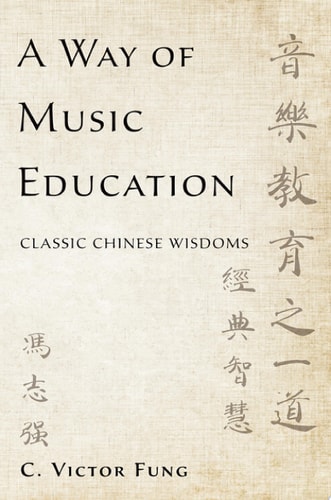
A Way of Music Education: Classic Chinese Wisdoms
0
0
As an Amazon Associate and affiliate partner, Menrva Books earns from qualifying purchases. Learn more
Author Description
Moving back through Dewey, Heidegger, Nietzsche, and Rousseau, the lineage of Western music education finds its origins in Plato and Pythagoras. Yet theories not rooted in the ancient Greek tradition are all but absent. A Way of Music Education provides a much-needed intervention, integrating ancient Chinese thought into the canon of music education in a structured, systematized, and philosophical way. The book's three central sources - the Yijing (The Book of Changes), Confucianism, and Daoism - inform author C. Victor Fung's argument: that the human being exists as an entity at the center of an organismic world in which all things and events, including music and music education, are connected. Fung ultimately proposes a new educational philosophy based on three key ideas in Chinese thought: change, balance, and liberation. A unique work, A Way of Music Education offers a universal approach engrained in a specific and ancient cultural tradition.
Menrva's Summary
THE THESIS
How can ancient Chinese philosophical traditions provide a necessary expansion to the Western-centric canon of music education? Author C. Victor Fung, a scholar in music education, utilizes the Yijing, Confucianism, and Daoism to construct a systematic framework that positions the human experience as an interconnected part of an organismic world. He argues that integrating these perspectives allows for a more universal approach to teaching and learning music.
THE SCOPE MAP
What You Will Find
- Philosophical integration of the Yijing, Confucianism, and Daoism into music pedagogy.
- A structured framework centered on the concepts of change, balance, and liberation.
- A comparative analysis contrasting Eastern thought with Western figures such as Dewey, Heidegger, and Plato.
Scope Limits
- The text does not provide a practical, step-by-step curriculum for classroom implementation.
- It does not cover contemporary popular music education methodologies or digital music instruction.
THE AUTHORITY PERSPECTIVE
Experts recognize this work as a significant contribution to the diversification of music education philosophy. Readers frequently note the academic density of the prose, which requires familiarity with both educational theory and classical Chinese thought.
Page Count:
240
Publication Date:
2018-01-04
Publisher:
Oxford University Press
ISBN-10:
0190234466
ISBN-13:
9780190234461
Philosophy
Kindle Store
Musical Genres
Music
Categories
Performance theory
Education Theory
Kindle eBooks
Music Education
Pedagogy
Chinese Philosophy
Community Tags
Similar Books