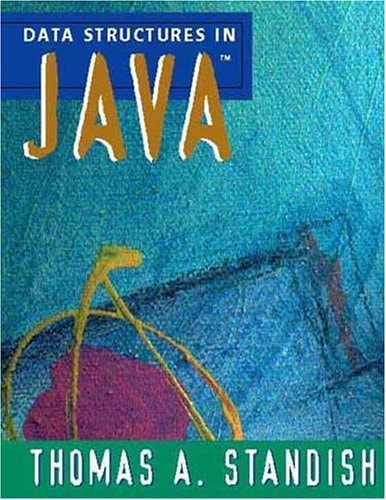
Data Structures in Java
0
0
As an Amazon Associate and affiliate partner, Menrva Books earns from qualifying purchases. Learn more
Author Description
Using Java(TM) 1.1, Professor Thomas A. Standish teaches the fundamentals of data structures and algorithms. With this exciting new language, Standish takes a fresh look at the subject matter. New challenges arise any time a new language is used, and the author meets these challenges. For example, although Java is a language without explicit pointers, this book offers pointer diagrams to help students visualize, reason about, and understand this major Data Structures topic. Standish's clear presentation helps readers tie the many concepts of data structures together with recurring themes. Central ideas - such as modularity, levels of abstraction, efficiency, and tradeoffs - serve as integrators in the book in order to tie the material together conceptually and to reveal its underlying unity and interrelationships. Highlights Reviews the fundamentals of object-oriented programming and Java in Chapter 2 and Appendix A, allowing students with no prior knowledge of Java to get up and running quickly. Creates a Java applet with a simple GUI in Chapter 2. Covers recursion early and carefully in Chapter 4 to help students grasp this challenging concept. Includes an introduction to modularity and data abstraction concepts in Chapter 5, and coverage of key software engineering concepts and skills in Appendix C. Contains common pitfall sections at the end of each chapter to help students recognize and avoid potential dangers.
Menrva's Summary
THE THESIS
This text investigates the fundamental principles of data structures and algorithms through the specific lens of the Java programming language. Professor Thomas A. Standish utilizes his academic background to bridge the gap between abstract computer science concepts and practical implementation in Java 1.1. The book argues that by focusing on recurring themes such as modularity, abstraction, and efficiency, students can achieve a unified understanding of software engineering despite the language's lack of explicit pointers.
THE SCOPE MAP
What You Will Find
- Comprehensive coverage of object-oriented programming fundamentals and Java syntax.
- Pedagogical tools including pointer diagrams to visualize memory management and data structures.
- Practical software engineering skills and modularity concepts integrated throughout the chapters.
- End-of-chapter common pitfall sections designed to identify and mitigate frequent student errors.
THE AUTHORITY PERSPECTIVE
Experts and educators recognize this work as a structured introduction to data structures for students transitioning into the Java environment. Readers frequently note the clarity of the author's presentation, particularly regarding the early introduction of recursion and the use of visual aids to explain complex memory concepts.
Page Count:
555
Publication Date:
1997-08-22
Publisher:
Addison Wesley
ISBN-10:
020130564X
ISBN-13:
9780201305647
Algorithms
Computer Science
Java
Programming
textbook
Community Tags
Similar Books