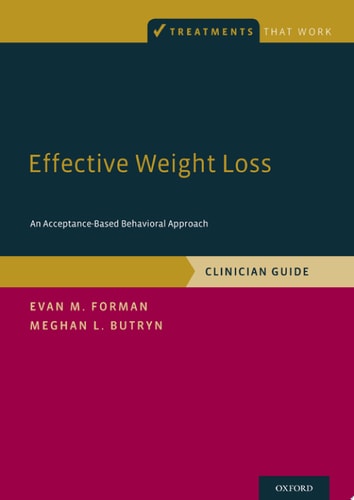
Effective Weight Loss: An Acceptance-Based Behavioral Approach, Clinician Guide
0
0
As an Amazon Associate and affiliate partner, Menrva Books earns from qualifying purchases. Learn more
Author Description
The obesity epidemic is one of the most serious public health threats confronting the nation and the world. The majority of overweight individuals want to lose weight, but the overall success of self-administered diets and commercial weight loss programs is very poor. Scientific findings suggest that the problem boils down to adherence. The dietary and physical activity recommendations that weight loss programs promote are effective; however, people have difficulty initiating and maintaining changes.Effective Weight Loss presents 25 detailed sessions of an empirically supported, cognitive-behavioral treatment package called Acceptance-Based Behavioral Treatment (ABT). The foundation of this approach is comprised of the nutritional, physical activity, and behavioral components of the most successful, gold-standard behavioral weight loss programs. These components are synthesized with acceptance, willingness, behavioral commitment, motivation, and relapse prevention strategies drawn from a range of therapies. ABT is based on the idea that specialized self-control skills are necessary for weight control, given our innate desire to consume delicious foods and to conserve energy by avoiding physical activity. These self-control skills revolve around a willingness to choose behaviors that may be perceived as uncomfortable, for the sake of a more valuable objective. The Clinician Guide is geared towards helping administer treatment, and the companion Workbook provides summaries of session content, exercises, worksheets, handouts, and assignments for patients and clients receiving the treatment. The books will appeal to psychologists, primary care physicians, nutritionists, dieticians, and other clinicians who counsel the overweight.
Menrva's Summary
THE THESIS
This book investigates the core question of why traditional weight loss programs frequently fail due to poor adherence and proposes Acceptance-Based Behavioral Treatment (ABT) as a solution. Authors Evan M. Forman and Meghan L. Butryn, both experts in behavioral health, synthesize gold-standard nutritional and physical activity guidelines with acceptance and commitment strategies. The framework argues that specialized self-control skills are necessary to overcome innate human tendencies toward energy conservation and high-calorie consumption.
THE SCOPE MAP
What You Will Find
- A 25-session structured treatment protocol for weight management.
- Strategies for fostering behavioral commitment and motivation.
- Techniques for relapse prevention and managing discomfort during lifestyle changes.
Scope Limits
- The text focuses specifically on the clinician-led application of ABT rather than self-help strategies for independent users.
- It does not cover pharmacological or surgical interventions for obesity.
THE AUTHORITY PERSPECTIVE
Clinicians and researchers identify this work as a rigorous, evidence-based resource for practitioners working in weight management. Experts highlight the text for its practical utility in bridging the gap between theoretical behavioral science and clinical application.
Page Count:
304
Publication Date:
2016-08-09
Publisher:
Oxford University Press
ISBN-10:
0190232005
ISBN-13:
9780190232009
Psychology
Health
Weight Loss
Behavioral Therapy
Nutrition
Community Tags
Similar Books