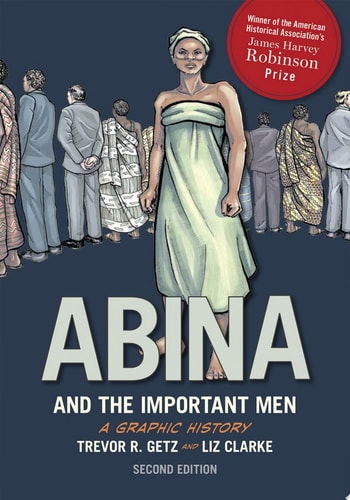
Abina and the Important Men: A Graphic History
0
0
As an Amazon Associate and affiliate partner, Menrva Books earns from qualifying purchases. Learn more
Author Description
Winner of the James Harvey Robinson Prize from the American Historical Association--and widely acclaimed by educators and students--Abina and the Important Men, Second Edition, is a compelling and powerfully illustrated "graphic history" based on an 1876 court transcript of a West African woman named Abina, who was wrongfully enslaved and took her case to court. The book is a microhistory that does much more than simply depict an event in the past; it uses the power of illustration to convey important themes in world history and to reveal the processes by which history is made.The story of Abina Mansah--a woman "without history" who was wrongfully enslaved, escaped to British-controlled territory, and then took her former master to court--takes place in the complex world of the Gold Coast at the onset of late nineteenth-century colonialism. Slavery becomes a contested ground, as cultural practices collide with an emerging wage economy and British officials turn a blind eye to the presence of underpaid domestic workers in the households of African merchants. The main scenes of the story take place in the courtroom, where Abina strives to convince a series of "important men"--a British judge, two Euro-African attorneys, and a jury of local leaders--that her experiences and perceptions matter. "Am I free?" Abina inquires. Throughout both the court case and the flashbacks that dramatically depict her life in servitude, both the defendants and members of the court strive to "silence" Abina and to impose their own understandings and meanings upon her.Following the graphic history in Part I, Parts II-V provide detailed historical context for the story, a reading guide that reconstructs and deconstructs the methods used to interpret the story, and strategies for using Abina in various classroom settings.This second edition features a new gender-rich section, Part V: Engaging Abina, which explores Abina's life and narrative as a woman. Focusing on such important themes as th
Menrva's Summary
THE THESIS
This work investigates the intersection of colonial law, gender, and slavery in the late nineteenth-century Gold Coast through the lens of a single legal case. Trevor R. Getz, a historian specializing in African history, utilizes a 1876 court transcript to reconstruct the experience of Abina Mansah, a woman who challenged her status as an enslaved person. The book argues that historical narratives are often constructed by those in power and seeks to recover the agency of marginalized individuals within the colonial legal framework.
THE SCOPE MAP
What You Will Find
- A graphic history narrative based on primary source court transcripts.
- Historical context regarding the Gold Coast during the onset of British colonialism.
- Methodological guides for interpreting historical documents and microhistories.
- Analysis of gender dynamics and domestic labor in colonial African households.
Scope Limits
- The narrative is confined to the specific legal case of Abina Mansah and does not provide a comprehensive history of the entire Gold Coast region.
- The graphic portion is a dramatized interpretation of the transcript rather than a verbatim record.
THE AUTHORITY PERSPECTIVE
Educators and historians frequently cite this text as a model for using graphic formats to teach complex historical methodology and primary source analysis. The book is widely recognized for its ability to make dense historical arguments accessible to students while maintaining academic rigor.
Page Count:
240
Publication Date:
2015-06-01
Publisher:
Oxford University Press
ISBN-10:
0190238747
ISBN-13:
9780190238742
Non-Fiction
History
Slavery africa
Graphic Novels
Law_ghana
Enslaved Women
Graphic Novel
African history
Legal History
Law And Legislation
Colonialism
Community Tags
Similar Books