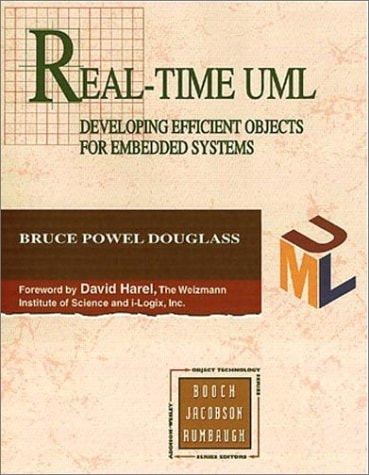
Real-Time UML: Developing Efficient Objects for Embedded Systems
0
0
As an Amazon Associate and affiliate partner, Menrva Books earns from qualifying purchases. Learn more
Author Description
Real-time systems programmers face unique challenges. Qualities such as execution speed and memory size are paramount in the development of real-time systems, and performance is a fundamental aspect of correctness in this domain. Given these constraints and requirements, it is fair to say that the development of real-time systems is more challenging than that of most software systems. Yet the lack of a standard notation and design process has discouraged embedded systems developers from adopting a revolutionary new approach to software design--object technology--that has produced clearly identifiable benefits in less specialized software applications.With the development and wide adoption of a standard notation, the Unified Modified Language (UML), real-time systems developers can now avail themselves of the benefits and advantages of object technology. UML is a 3rd generation modeling language which rigorously defines the semantics of the object metamodel and provides a notation for capturing and communicating object structure and behavior. It is particularly well-suited to modeling real-time and embedded systems. Real-Time UML is the introduction that developers of real-time systems need to make the transition to object-oriented analysis and design and modeling with UML. It covers the important features of the UML and shows how to effectively use the UML to model real-time systems. The book includes special in-depth discussions of finite state machines, object identification strategies, and real-time design patterns to help beginning and experienced developers alike.
Menrva's Summary
THE THESIS
This book investigates how the Unified Modeling Language (UML) can be adapted to address the specific performance and memory constraints inherent in real-time and embedded systems development. Bruce Powel Douglass and David Harel leverage their expertise in software architecture to provide a framework for transitioning from traditional procedural methods to object-oriented analysis. The authors argue that by applying rigorous object-oriented design patterns and state machine modeling, developers can achieve the execution speed and reliability required for high-stakes embedded applications.
THE SCOPE MAP
What You Will Find
- Comprehensive overview of UML notation tailored for real-time constraints
- Methodologies for object identification in embedded environments
- In-depth technical analysis of finite state machines and their implementation
- Practical design patterns specifically optimized for real-time system performance
THE AUTHORITY PERSPECTIVE
Experts recognize this work as a foundational text for bridging the gap between general object-oriented design and the specialized requirements of embedded programming. Readers frequently note the technical density of the prose, which serves as a practical manual for engineers seeking to standardize their development processes.
Page Count:
363
Publication Date:
1997-01-01
Publisher:
Addison-Wesley
ISBN-10:
0201325799
ISBN-13:
9780201325799
Computer Science
Programming
Software Engineering
Technology
Community Tags
Similar Books