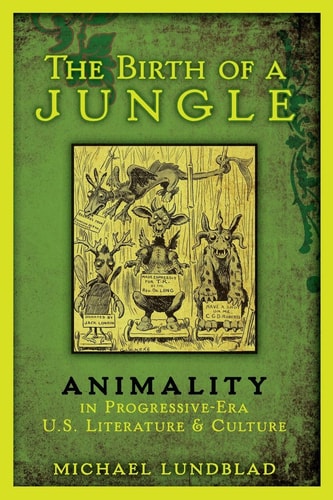
The Birth of a Jungle: Animality in Progressive-Era U.S. Literature and Culture
0
0
As an Amazon Associate and affiliate partner, Menrva Books earns from qualifying purchases. Learn more
Author Description
According to the law of the jungle, the behavior of wild animals can be equated with natural human instincts not only for competition and reproduction, but also for violence and exploitation. Drawing on numerous novels and cultural events at the turn of the twentieth century, The Birth of a Jungle examines how the characteristics and imagery of wild animals were evoked to explore a wide range of human behaviors, including homosexuality, labor exploitation, and the lynching of African Americans.Throughout the study, Michael Lundblad emphasizes what he terms "the discourse of the jungle": Darwinist-Freudian constructions of "the human" and "the animal" that redefined various behaviors in relation to animal instincts. With nuanced, attentive readings, Lundblad reveals how these formulations of the human animal, despite reigning critical interpretations, were often contested rather than reinforced in Progressive-Era texts. Henry James's "The Beast in the Jungle" and fiction by Jack London serve as opportunities to examine changing attitudes toward sexuality and queer desire. Works like Andrew Carnegie's The Gospel of Wealth and Frank Norris's The Octopus offer insights into another type of jungle: the capitalist marketplace. The real-life electrocution of a circus elephant at Coney Island and Upton Sinclair's muckraking classic, The Jungle, inform the subsequent discussion of animalized class warfare. Understandings of race and evolution are explored through the work of William James, Edgar Rice Burrough's Tarzan of the Apes, and the role of William Jennings Bryan at the Scopes "Monkey Trial" of 1925.Engagingly written and cogently argued, The Birth of a Jungle reveals the significance of animality in relation to the history of sexuality, literary naturalism, and critical race studies, while highlighting how the discourse of the jungle remains a disturbing yet powerful presence in today's culture.
Menrva's Summary
THE THESIS
How did the discourse of the jungle function as a framework for defining human behavior and social hierarchies during the American Progressive Era? Michael Lundblad, an academic specializing in literary and cultural studies, utilizes a multidisciplinary approach to investigate the intersection of Darwinist-Freudian thought and the construction of animality. He argues that the period's literature and cultural events frequently employed animal imagery to navigate complex issues of race, class, and sexuality, often challenging the very definitions of humanity they purported to establish.
THE SCOPE MAP
What You Will Find
- Analysis of literary works by authors such as Henry James, Jack London, Frank Norris, Upton Sinclair, and Edgar Rice Burroughs.
- Examination of cultural phenomena including the Coney Island elephant electrocution and the Scopes Monkey Trial.
- Application of the "discourse of the jungle" framework to themes of labor exploitation, queer desire, and racial violence.
Scope Limits
- The study focuses primarily on the United States during the late nineteenth and early twentieth centuries.
- It does not provide a comprehensive history of animal rights movements or biological science outside of their cultural and literary applications.
THE AUTHORITY PERSPECTIVE
Scholars in the fields of literary naturalism and animal studies recognize this work as a significant contribution to understanding how animal metaphors shaped American social identity. Readers frequently note the academic density of the prose and the author's meticulous attention to the nuances of Progressive-Era texts.
Page Count:
234
Publication Date:
2015-02-11
Publisher:
Oxford University Press
ISBN-10:
0190231580
ISBN-13:
9780190231583
History
Animal Studies
Literary Criticism
American
In literature
Community Tags
Similar Books