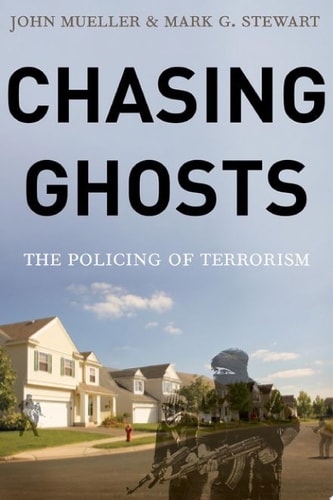
Chasing Ghosts: The Policing of Terrorism
0
0
As an Amazon Associate and affiliate partner, Menrva Books earns from qualifying purchases. Learn more
Author Description
Since 2001, the United States has created or reorganized more than two counterterrorism organizations for every apprehension it has made of Islamists apparently planning to commit terrorism within the country. Central to this massive enterprise is what the FBI frequently calls "ghost-chasing"-the efforts by police and intelligence agencies to follow up on over ten million tips. Less than one alarm in 10,000 fails to be false-the rest all point to ghosts. And the vast majority of the leads deemed to be productive have led to terrorist enterprises that are either trivial or at most aspirational. As John Mueller and Mark G. Stewart suggest in Chasing Ghosts, it is often an exercise in dueling delusions: an extremist has delusions about changing the world by blowing something up, and the authorities have delusions that he might actually be able to overcome his patent inadequacies to do so.Chasing Ghosts systematically examines this expensive, exhausting, bewildering, chaotic, and paranoia-inducing process. It evaluates the counterterrorism efforts of the FBI, the National Security Agency, the Department of Homeland Security, and local policing agencies. In addition, it draws from a rich set of case studies to appraise the capacities of the terrorist "adversary" and to scrutinize "the myth of the mastermind." Mueller and Stewart also look closely at public opinion, a key driving force in counterterrorism efforts. The chance that an American will be killed by a terrorist within the country is about one in four million per year under present conditions. However, poll data suggest that, although over a trillion dollars has been spent on domestic counterterrorism since 2001, Americans say they do not feel safer. No defense of civil liberties is likely to be effective as long as people and officials continue to believe that the threat from terrorism is massive, even existential.
Menrva's Summary
THE THESIS
Does the massive expenditure and organizational growth of post-9/11 domestic counterterrorism produce a commensurate increase in public safety? John Mueller, a political scientist, and Mark G. Stewart, an expert in risk assessment, utilize extensive data on federal agency operations and threat analysis to argue that current counterterrorism efforts are disproportionate to the actual risk posed by domestic threats. They contend that the system is driven by institutional paranoia and public perception rather than a realistic appraisal of terrorist capabilities.
THE SCOPE MAP
What You Will Find
- Analysis of FBI, NSA, and Department of Homeland Security counterterrorism operations.
- Quantitative assessment of domestic terrorist threats versus resource allocation.
- Case studies examining the 'myth of the mastermind' in foiled plots.
- Evaluation of public opinion data regarding perceived safety and government spending.
Scope Limits
- The text does not provide a comprehensive history of international intelligence operations outside of the United States.
- It does not offer a detailed tactical manual for law enforcement procedures.
THE AUTHORITY PERSPECTIVE
Experts in national security and public policy frequently cite this work as a critical examination of the cost-benefit ratio in modern counterterrorism. Readers often note the academic rigor of the authors' statistical approach while highlighting the provocative nature of their conclusions regarding government spending.
Page Count:
402
Publication Date:
2015-11-30
Publisher:
Oxford University Press
ISBN-10:
0190237317
ISBN-13:
9780190237318
United States
National security
Public Policy
Terrorism
International Security
Criminology
Government accountability
Community Tags
Similar Books