Spinning Wheels
0
0
As an Amazon Associate and affiliate partner, Menrva Books earns from qualifying purchases. Learn more
Author Description
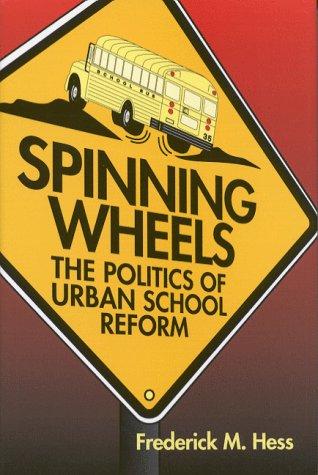
Almost everyone agrees that America's urban schools are a mess. But while this agreement has fostered widespread support for aggressive reform, Frederick Hess argues that much of what ails urban education is actually the result of continuous or fragmentary reform. Hess argues that policymakers have misallocated resources by pursuing the "right" structure or the "best" pedagogy while paying insufficient attention to the more mundane - and more important - questions of how to implement, refine, and sustain a particular approach in their particular district. Previous research on high-performing schools suggests that the best schools are characterized by focus and by an ability to develop expertise in specific approaches to teaching and learning. To help educators and policymakers adopt and nurture a focused agenda, Hess recommends institutional changes that increase the effectiveness of performance outcomes and reduce the incentives to emphasize symbolic reform.
Menrva's Summary
THE THESIS
The central problem addressed is the persistent underperformance of America's urban schools and the ineffectiveness of continuous or fragmentary reform efforts. Frederick M. Hess, drawing on his expertise in education policy, argues that policymakers have historically misdirected resources by prioritizing structural or pedagogical innovations over the crucial, yet often neglected, aspects of implementation, refinement, and sustained practice within specific districts. He posits that high-performing schools achieve success through a combination of focused agendas and the cultivation of specialized expertise in teaching and learning methodologies. To counter the trend of symbolic reform and enhance educational outcomes, Hess proposes institutional changes designed to bolster the effectiveness of performance metrics and diminish the allure of superficial reforms.
THE SCOPE MAP
- Analysis of the impact of continuous and fragmentary reform on urban school performance.
- Critique of resource misallocation in educational policy.
- Examination of the characteristics of high-performing schools, focusing on specialization and expertise.
- Recommendations for institutional changes to improve implementation and sustain educational approaches.
- Discussion of strategies to increase the effectiveness of performance outcomes in education.
- Identification of incentives that promote symbolic reform over substantive change.
THE AUTHORITY PERSPECTIVE
The book is recognized for its critical examination of educational reform, particularly its argument that the constant pursuit of new initiatives can be detrimental to urban school improvement. Hess's thesis suggests that a focus on implementation and sustained practice, rather than novel structures or pedagogies, is key to developing effective educational environments. The work is positioned as a contribution to policy discussions, advocating for institutional adjustments that prioritize measurable outcomes and discourage superficial reforms. The perspective offered is one that challenges conventional approaches to educational change.
Page Count:
228
Publication Date:
1999-01-01
ISBN-10:
0815736363
Politics
Economics
Non-Fiction
Policy
Education
Urban Studies
Community Tags
Similar Books