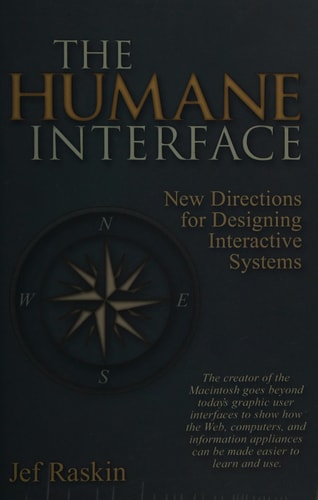
The Humane Interface: New Directions for Designing Interactive Systems
0
0
As an Amazon Associate and affiliate partner, Menrva Books earns from qualifying purchases. Learn more
Author Description
This unique guide to interactive system design reflects the experience and vision of Jef Raskin, the creator of the Apple Macintosh project. Other books may show how to use today's widgets and interface ideas effectively. Raskin, however, demonstrates that many current interface paradigms are dead ends, and that to make computers significantly easier to use requires new approaches. He explains how to effect desperately needed changes, offering a wealth of innovative and specific interface ideas for software designers, developers, and product managers. The Apple Macintosh helped to introduce a previous revolution in computer interface design, drawing on the best available technology to establish many of the interface techniques and methods now universal in the computer industry. With this book, Raskin proves again both his farsightedness and his practicality. He also demonstrates how design ideas must be built on a scientific basis, presenting just enough cognitive psychology to link the interface of the future to the experimental evidence and to show why that interface will work. Raskin observes that our honeymoon with digital technology is over: We are tired of having to learn huge, arcane programs to do even the simplest of tasks; we have had our fill of crashing computers; and we are fatigued by the continual pressure to upgrade. The Humane Interface delivers a way for computers, information appliances, and other technology-driven products to continue to advance in power and expand their range of applicability, while becoming free of the hassles and obscurities that plague present products.
Menrva's Summary
THE THESIS
Can computer interfaces be redesigned to prioritize human cognitive efficiency over existing, flawed paradigms? Jef Raskin, the primary architect of the Apple Macintosh, argues that current interface standards are fundamentally counterproductive. He proposes a rigorous, science-based framework for software design that replaces complex, arcane systems with intuitive, user-centered alternatives grounded in cognitive psychology.
THE SCOPE MAP
What You Will Find
- Analysis of current interface paradigms and their limitations
- Principles of cognitive psychology applied to software usability
- Methodologies for designing information appliances
- Strategies for reducing user fatigue and system complexity
THE AUTHORITY PERSPECTIVE
Experts and practitioners frequently cite this work as a foundational text for understanding the intersection of human cognition and software design. Readers often note that while the prose is accessible, the arguments provide a dense, challenging critique of industry-standard interface practices.
Page Count:
233
Publication Date:
2000-01-01
Publisher:
Addison-Wesley Professional
ISBN-10:
0201379376
ISBN-13:
9780201379372
Software Engineering
Computer Science
Design
Computer Interfaces
Technology
Community Tags
Similar Books