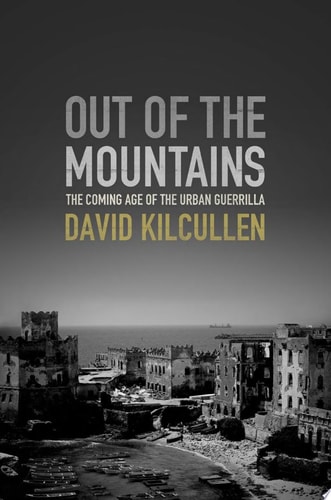
Out of the Mountains: The Coming Age of the Urban Guerrilla
0
0
As an Amazon Associate and affiliate partner, Menrva Books earns from qualifying purchases. Learn more
Author Description
In Out of the Mountains, David Kilcullen, one of the world's leading experts on modern warfare, offers a look ahead at what may happen after the war in Afghanistan ends. It is a book about future conflicts and future cities, about the challenges and opportunities that four powerful megatrends are creating across the planet. And it is about what national governments, cities, communities and businesses can do to prepare for a future in which all aspects of human society-including, but not limited to, conflict, crime and violence-are rapidly changing. Kilcullen analyzes four megatrends--population growth, urbanization, coastal life, and connectedness-and concludes that future conflict is increasingly likely to occur in sprawling coastal cities, in underdeveloped regions of the Middle East, Africa, Latin America and Asia, and in highly networked, connected settings. He ranges across the globe, from Kingston to Mogadishu to Honduras to Benghazi to Mumbai. Mumbai exemplifies the trend: a coastal megacity, terrorists based in nearby Karachi exploited new forms of connectivity to direct a horrific terrorist attack. Kilcullen also offers a unified theory of "competitive control" that shows how non-state armed groups, drug cartels, street gangs, warlords--draw their strength from local populations, providing useful ideas for dealing with these groups and with diffuse social conflicts in general. But for many of the struggles we will face, he notes, there will be no military solution. We will need to involve local people deeply to address problems which neither outsiders nor locals alone can solve. These collaborations will interweave the insight only locals can bring, with outsider knowledge from fields such as urban planning, systems engineering, alternative energy technology, conflict resolution and mediation, and other disciplines. Deeply researched and compellingly argued, Out of the Mountains provides an invaluable roadmap to a future that will increasing
Menrva's Summary
THE THESIS
This book investigates how four global megatrends—population growth, urbanization, coastal migration, and digital connectivity—are fundamentally altering the nature of future conflict and urban violence. David Kilcullen, a former Australian army officer and advisor to the U.S. government, utilizes his extensive field experience and academic background in counterinsurgency to construct a framework for understanding modern non-state threats. He argues that traditional military solutions are increasingly insufficient, proposing instead a theory of 'competitive control' that emphasizes local engagement and interdisciplinary collaboration to address the rise of urban guerrillas, gangs, and cartels.
THE SCOPE MAP
What You Will Find
- Analysis of four primary megatrends: population growth, urbanization, coastal living, and global connectivity.
- A unified theory of 'competitive control' regarding how non-state actors gain influence within local populations.
- Case studies of urban conflict in locations including Mumbai, Mogadishu, Kingston, and Benghazi.
- Interdisciplinary strategies for conflict resolution involving urban planning, systems engineering, and mediation.
Scope Limits
- The text does not provide a comprehensive military manual for conventional state-on-state warfare.
- It does not offer specific policy prescriptions for every individual nation-state, focusing instead on broad systemic trends.
THE AUTHORITY PERSPECTIVE
Experts in security studies and international relations frequently cite this work as a foundational text for understanding the shift from rural insurgency to urban-based conflict. Readers often note the academic density of the prose, which balances high-level strategic theory with granular observations from global conflict zones.
Page Count:
352
Publication Date:
2015-07-01
Publisher:
Oxford University Press
ISBN-10:
0190230967
ISBN-13:
9780190230968
Sociology
International relations
Security Studies
Urban Studies
Military Strategy
Geopolitics
Insurgency
Community Tags
Other Editions(2)

Similar Books













Reader Comments
Share Your Thoughts
No comments yet. Be the first to share your thoughts!