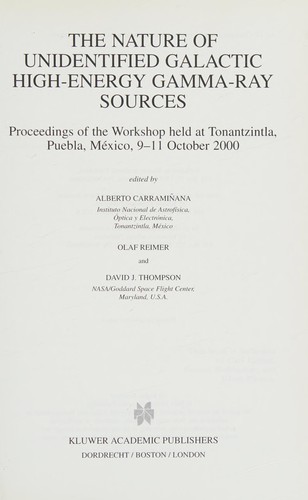
The Nature of Unidentified Galactic High-Energy Gamma-Ray Sources
0
0
As an Amazon Associate and affiliate partner, Menrva Books earns from qualifying purchases. Learn more
Author Description
This is the first book dedicated to unidentified celestial gamma-ray sources. The launch of the Compton Gamma-Ray Observatory allowed the first all-sky surveys in gamma-rays, the most energetic form of electromagnetic radiation. The Energetic Gamma-Ray Experiment Telescope discovered more than 270 sources of high-energy protons, more than half of which are not identified with known celestial objects. Most of these objects belong to the Milky Way and more than one class of sources are present among the unidentified sources. Unravelling the nature of all these objects requires the combination of different sorts of instruments, like radio telescopes, optical telescopes, and X-ray satellites, together with the next generations of space and ground-based gamma-ray telescopes. This book presents the current knowledge on the subject and outlines strategies for identification of objects with current astronomical facilities. It provides a forward look by outlining the prospects of future generation gamma-ray telescopes. The contributions are detailed and represent valuable material for undergraduate and postgraduate astrophysics students and researchers in the field.
Menrva's Summary
THE THESIS
This book addresses the fundamental challenge of identifying the sources of high-energy gamma-ray emissions in the galaxy. The launch of the Compton Gamma-Ray Observatory revolutionized the study of these phenomena, revealing over 270 previously unknown sources. The author, David J. Thompson, presents the current state of knowledge regarding these unidentified objects, many of which reside within the Milky Way. The text outlines the necessity of combining data from various astronomical instruments and proposes strategies for future identification efforts.
THE SCOPE MAP
- Detailed analysis of unidentified celestial gamma-ray sources.
- Discussion of data from the Energetic Gamma-Ray Experiment Telescope.
- Exploration of the need for multi-instrumental astronomical observation (radio, optical, X-ray, gamma-ray).
- Strategies for identifying unknown gamma-ray sources with current facilities.
- Prospects and outlook for future generation gamma-ray telescopes.
- Valuable material for astrophysics students and researchers.
THE AUTHORITY PERSPECTIVE
This book is presented as a comprehensive overview for astrophysics students and researchers, detailing the current knowledge and future strategies for identifying high-energy gamma-ray sources. The text emphasizes the collaborative nature of modern astronomy, requiring the integration of data from diverse observational tools. It serves as a foundational resource for understanding the challenges and advancements in this specialized field of astrophysics.
Page Count:
355
Publication Date:
2001-01-01
ISBN-10:
1402000103
Non-Fiction
Science
Art
Astrophysics
Research
Astronomy
Community Tags
Similar Books