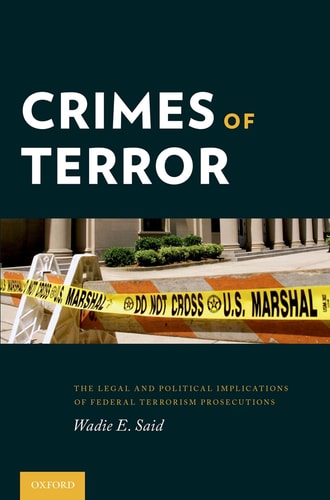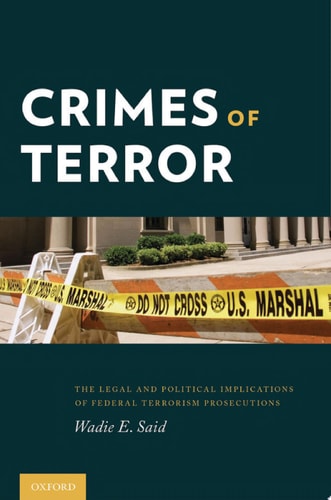
Crimes of Terror: The Legal and Political Implications of Federal Terrorism Prosecutions
0
0
As an Amazon Associate and affiliate partner, Menrva Books earns from qualifying purchases. Learn more
Author Description
The U.s. Government's Power To Categorize Individuals As Terrorist Suspects And Therefore Ineligible For Certain Long-standing Constitutional Protections Has Expanded Exponentially Since 9/11, All The While Remaining Resistant To Oversight. Crimes Of Terror: The Legal And Political Implications Of Federal Terrorism Prosecutions Provides A Comprehensive And Uniquely Up-to-date Dissection Of The Government's Advantages Over Suspects In Criminal Prosecutions Of Terrorism, Which Are Driven By A Preventive Mindset That Purports To Stop Plots Before They Can Come To Fruition. It Establishes The Background For These Controversial Policies And Practices And Then Demonstrates How They Have Impeded The Normal Goals Of Criminal Prosecution, Even In Light Of A Competing Military Tribunal Model. Proceeding In A Linear Manner From The Investigatory Stage Of A Prosecution On Through To Sentencing, The Book Documents The Emergence Of A Terrorist Exceptionalism To Normal Rules Of Criminal Law And Procedure And Questions Whether The Government Has Overstated The Threat Posed By The Individuals It Charges With These Crimes. Included Is A Discussion Of The Large-scale Spying And Use Of Informants Rooted In The Questionable Radicalization Theory; The Material Support Statute--the Government's Chief Legal Tool In Bringing Criminal Prosecutions; The New Rules Regarding Generation Of Evidence And The Broad Construction Of That Evidence As Relevant At Trial; And A Look At The Special Sentencing And Confinement Regimes For Those Convicted Of Terrorist Crimes. In This Critical Examination Of Terrorism Prosecutions In Federal Court, Professor Said Reveals A Phenomenon At Odds With Basic Constitutional Protections For Criminal Defendants.
Menrva's Summary
THE THESIS
This book investigates how the expansion of federal terrorism prosecutions since 9/11 has created a system of 'terrorist exceptionalism' that undermines traditional constitutional protections for criminal defendants. Wadie E. Said, a professor of law, utilizes his expertise in criminal procedure and international law to analyze the shift toward a preventive mindset in the American legal system. He argues that the government's reliance on broad statutes and questionable investigative theories has fundamentally altered the balance of power between the state and the accused.
THE SCOPE MAP
What You Will Find
- Analysis of the material support statute as a primary prosecutorial tool
- Examination of radicalization theory and the use of informants in investigations
- Review of evidentiary standards and special sentencing regimes for terrorism convictions
- Documentation of the transition from traditional criminal law to a preventive model
Scope Limits
- The text focuses primarily on federal court prosecutions rather than military tribunal proceedings
- It does not provide a comprehensive history of global counter-terrorism policy outside the United States
THE AUTHORITY PERSPECTIVE
Legal scholars and practitioners frequently cite this work for its detailed dissection of the procedural hurdles faced by defendants in terrorism cases. Experts highlight the book as a rigorous examination of how national security priorities have reshaped federal criminal litigation.
Page Count:
200
Publication Date:
2015-01-01
Publisher:
Oxford University Press
ISBN-10:
0190234164
ISBN-13:
9780190234164
Constitutional Law
Law
Human rights
Terrorism