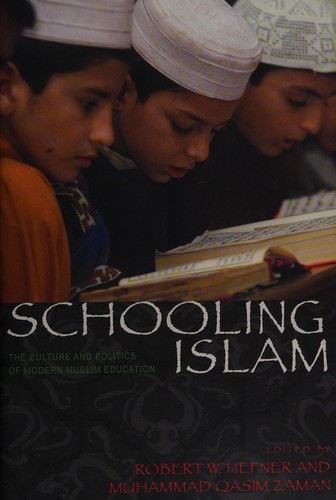
Schooling Islam
0
0
As an Amazon Associate and affiliate partner, Menrva Books earns from qualifying purchases. Learn more
Author Description
Since the Taliban seized Kabul in 1996, the public has grappled with the relationship between Islamic education and radical Islam. Media reports tend to paint madrasas --religious schools dedicated to Islamic learning -- as medieval institutions opposed to all that is Western and as breeding grounds for terrorists. Others have claimed that without reforms, Islam and the West are doomed to a clash of civilizations. Robert Hefner and Muhammad Qasim Zaman bring together eleven internationally renowned scholars to examine the varieties of modern Muslim education and their implications for national and global politics. The contributors provide new insights into Muslim culture and politics in countries as different as Morocco, Egypt, Pakistan, India, Indonesia, Iran, and Saudi Arabia. They demonstrate that Islamic education is neither timelessly traditional nor medieval, but rather complex, evolving, and diverse in its institutions and practices. They reveal that a struggle for hearts and minds in Muslim lands started long before the Western media discovered madrasas, and that Islamic schools remain on its front line. Schooling Islam is the most comprehensive work available in any language on madrasas and Islamic education.
Menrva's Summary
THE THESIS
This book investigates the complex and diverse nature of modern Muslim education and its significant implications for global politics. The contributors, a group of eleven internationally renowned scholars, examine the varieties of Islamic educational institutions and practices across countries such as Morocco, Egypt, Pakistan, India, Indonesia, Iran, and Saudi Arabia. They challenge the common perception of madrasas as static, medieval institutions, demonstrating instead that they are dynamic, evolving entities. The work reveals that these schools have long been central to ideological struggles in Muslim lands, predating recent media attention.
THE SCOPE MAP
- Analysis of modern Muslim education systems in diverse geopolitical contexts.
- Examination of the historical evolution and contemporary practices of madrasas.
- Exploration of the relationship between Islamic education and national/global politics.
- Case studies from Morocco, Egypt, Pakistan, India, Indonesia, Iran, and Saudi Arabia.
- Debunking of the notion that Islamic education is inherently traditional or anti-Western.
- Insights into the ideological struggles occurring within Muslim communities.
THE AUTHORITY PERSPECTIVE
The collection challenges prevailing media narratives that often portray Islamic educational institutions, particularly madrasas, as monolithic, backward, and solely responsible for radicalism. Contributors highlight the diversity and adaptability of these schools, demonstrating their complex role in contemporary Muslim societies and their engagement with political and ideological currents. The work is recognized for providing a nuanced and comprehensive overview of Muslim education, moving beyond simplistic stereotypes to offer a more accurate understanding of its multifaceted nature and its significance in shaping both local and international affairs.
Page Count:
276
Publication Date:
2006-01-01
ISBN-10:
0691129320
ISBN-13:
9780691129327
Politics
Religion
History
Non-Fiction
Education
Sociology
Community Tags
Similar Books