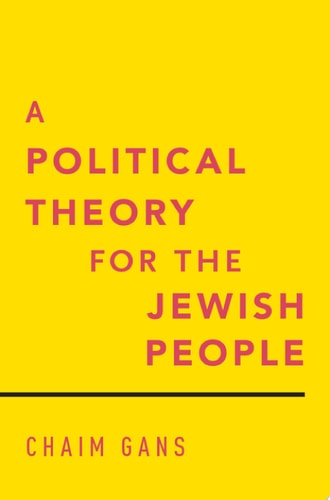
A Political Theory for the Jewish People
0
0
As an Amazon Associate and affiliate partner, Menrva Books earns from qualifying purchases. Learn more
Author Description
Chaim Gans's A Political Theory for the Jewish People examines the two dominant interpretations of Zionism, contrasts them with post-Zionist alternatives, and develops a third model. Along with exploring the historiographic, philosophical and moral foundations of each of these approaches, Gans considers their implications for the relationship between Jews and Arabs in Israel/Palestine as well as the relationship between Israeli and diasporic Jews.Proprietary Zionism, Gans argues, is the version that is most popular among the Israeli Jewish public. It conceives of the land of Israel/historic Palestine as the property of the Jewish people. It also conceives of the entire Jewish people as belonging to Israel. Hierarchical Zionism is common among Israel's educated elites and interprets the Jewish right to self-determination as a right to hegemony within the Israeli state. It remains silent on the issue of the relationship between Israeli and non-Israeli Jews. Post-Zionist approaches, conversely, thoroughly reject these Zionist narratives regarding Jewish history and critique the rationale for the continued existence of the state of Israel as a Jewish state.Gans disagrees with all of these approaches, and in their stead advocates egalitarian Zionism, which is based on an egalitarian interpretation of the right to national self-determination and derives from the justifications for Zionism in its early years. As such, it interprets the historical link between the Jews and the land of Israel in terms of identity rather than property. It also views the link between Israel and world Jewry as a matter of choice for individual Jews--not as a matter of necessity, inextricably bound to their essence as Jews. He sees it as preferable to both the dominant strands of Zionism but also to the major contemporary anti-Zionist approaches: first, that of the Israeli post-Zionists offering a civic or post-colonial vision of a non-Jewish state, and, secondly, that of the mostly American pos
Menrva's Summary
THE THESIS
What is the most morally defensible framework for the state of Israel that balances the right to national self-determination with egalitarian principles? Chaim Gans, a professor of legal and political philosophy, evaluates the historical and moral foundations of existing Zionist and post-Zionist ideologies. He argues that current dominant models rely on problematic assumptions regarding property rights and ethnic hegemony, proposing instead a model of 'egalitarian Zionism' that prioritizes identity over territorial ownership and individual choice over collective necessity.
THE SCOPE MAP
What You Will Find
- A comparative analysis of Proprietary Zionism, Hierarchical Zionism, and post-Zionist political models.
- A philosophical framework for national self-determination applied to the Israeli-Palestinian context.
- An exploration of the relationship between the Israeli state and the global Jewish diaspora.
Scope Limits
- The text focuses primarily on political and moral theory rather than a comprehensive historical narrative of the region.
- It does not provide a detailed policy roadmap for immediate diplomatic implementation.
THE AUTHORITY PERSPECTIVE
Scholars and political theorists frequently cite this work as a rigorous contribution to the debate on the legitimacy of the Jewish state. Readers often note the high level of academic density and the systematic nature of Gans's philosophical arguments.
Page Count:
320
Publication Date:
2016-01-08
Publisher:
Oxford University Press
ISBN-10:
0190237546
ISBN-13:
9780190237547
Philosophy
Political Theory
Middle Eastern
Zionism
Jewish nationalism
Jewish Studies
Community Tags
Other Editions(4)


Similar Books








Reader Comments
Share Your Thoughts
No comments yet. Be the first to share your thoughts!