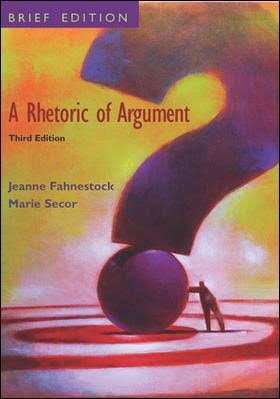
A Rhetoric of Argument
0
0
As an Amazon Associate and affiliate partner, Menrva Books earns from qualifying purchases. Learn more
Author Description
When it was first published in 1982, A Rhetoric of Argument developed a ground-breaking new approach to teaching argument. The stasis approach pioneered by Fahnestock and Secor distinguished among the four basic questions that arguments are written to answer: What is it? (Definition arguments) How did it get that way? (Causal arguments) Is it good or bad? (Evaluation arguments) What should we do about it? (Proposal arguments) These four questions, now standard in many argument texts, give students a constructive, engaging way to analyze readings by other writers and to construct their own arguments.
Menrva's Summary
THE THESIS
A Rhetoric of Argument introduces a foundational framework for understanding and constructing arguments, known as the stasis approach. This approach, developed by Jeanne Fahnestock and Philip Secor, categorizes arguments based on the fundamental questions they aim to answer: definition, causation, evaluation, and proposal. These categories provide students with a structured method for dissecting existing texts and for building their own persuasive writing. The book aims to equip readers with analytical tools applicable across various academic and rhetorical contexts.
THE SCOPE MAP
- What is it? (Definition arguments)
- How did it get that way? (Causal arguments)
- Is it good or bad? (Evaluation arguments)
- What should we do about it? (Proposal arguments)
- Analysis of existing texts through the stasis framework
- Guidance on constructing original arguments
- Application of rhetorical principles to academic writing
THE AUTHORITY PERSPECTIVE
When first published in 1982, 'A Rhetoric of Argument' introduced a novel approach to teaching argumentation through its pioneering stasis system. This framework, which categorizes arguments by the core questions they address (definition, causation, evaluation, proposal), has become a standard element in many contemporary argument textbooks. The book is recognized for providing students with a constructive and engaging method for both analyzing others' writing and developing their own.
Page Count:
540
Publication Date:
2004-01-01
ISBN-10:
0073036161
Non-Fiction
Religion
Argumentation
Rhetoric
Community Tags
Similar Books