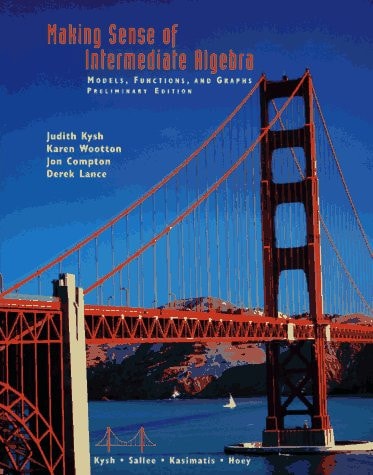
Making Sense of Intermediate Algebra: Models, Functions and Graphs
0
0
As an Amazon Associate and affiliate partner, Menrva Books earns from qualifying purchases. Learn more
Author Description
1. Problem Solving. Problem-solving strategies: Using "guess and check" tables, writing equations, graphing data, solving subproblems. Solving linear and quadratic equations. Introduction to the function concept. 2. Functions. Function notation, domain and range. Using a graphing calculator to investigate functions. Fitting lines to data. Writing equations for lines using slope and intercepts. Finding x- and y-intercepts and intersection points for lines by solving linear equations. Finding x- and y- intercepts for parabolas by solving quadratic equations. 3. Sequences as Discrete Functions. Developing sequences from data. Graphing sequences. Using formulas for th terms in arithmetic and geometric sequences. Definitions of continuous versus discrete functions. Relating arithmetic sequences to linear functions. Review of solving systems of equations. 4. Exponential Functions. Seeing geometric sequences as discrete exponential functions. Using integer and noninteger exponents. Relating fractional exponents and radicals. Introduction to solving exponential equations. Writing exponential equations to represent growth or decay. 5. Translating Graphs of Parabolas and Other Functions. Definition of a function. Using the quadratic equation to identify the location of the vertex and the stretch factor for the graph of a parabola. Changing quadratic expressions from standard form to graphing form. Generalizing relationships between equations and graphs for cubic, exponential, and square-root functions. Writing equations for parabolas given their graphs. Introduction to non-functions: parabolas of the form x = y2. 6. Linear Systems. Solving systems of inequalities. Applications of linear inequalities. Solving systems of three equations in three variables. Writing equations for parabolas given three points. 7. Logarithms and Other Inverse Functions. Definition of inverse function. Finding the inverse function (or relation) for a given function. Relating inverse functions and th
Menrva's Summary
THE THESIS
This text investigates the foundational concepts of intermediate algebra by emphasizing the integration of mathematical models, functional analysis, and graphical representation. The authors, a team of experienced mathematics educators, utilize a pedagogical framework that prioritizes problem-solving strategies and the conceptual understanding of functions over rote memorization. By connecting algebraic expressions to real-world data and visual graphs, the book provides a structured approach for students to master linear, quadratic, and exponential relationships.
THE SCOPE MAP
What You Will Find
- Comprehensive coverage of linear and quadratic equations, including intercept analysis and intersection points.
- Methodologies for utilizing graphing calculators to investigate and visualize function behavior.
- Analysis of sequences as discrete functions and their relationship to continuous linear and exponential models.
- Instruction on logarithmic functions, inverse relations, and systems of inequalities.
THE AUTHORITY PERSPECTIVE
Educators and students frequently note the practical, model-based approach of this text in bridging the gap between basic algebra and advanced calculus. Experts highlight this as a useful resource for developing algebraic intuition through the systematic application of graphing and data analysis.
Page Count:
400
Publication Date:
1997-01-01
Publisher:
Addison-Wesley
ISBN-10:
0201499959
ISBN-13:
9780201499957
Algebra
Education
Reference
Mathematics
textbook
Community Tags
Similar Books

Reader Comments
Share Your Thoughts
No comments yet. Be the first to share your thoughts!