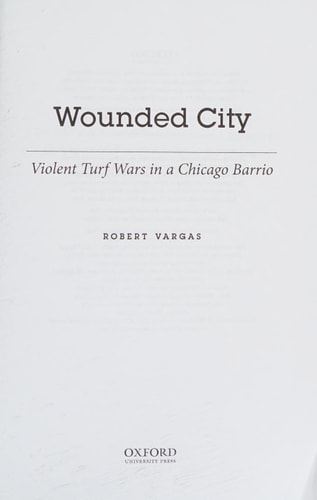
Wounded City
0
0
As an Amazon Associate and affiliate partner, Menrva Books earns from qualifying purchases. Learn more
Author Description
In 2009, Chicago Spent Millions Of Dollars To Create Programs To Prevent Gang Violence In Some Of Its Most Disadvantaged Neighborhoods. Yet In Spite Of The Programs, Violence Has Grown Worse In Some Of The Very Neighborhoods That The Violence Prevention Programs Were Intented To Help. While Public Officials And Social Scientists Often Attribute The Violence - And The Failure Of The Programs - To A Lack Of Community In Poor Neighborhoods, Closer Study Reveals Another Source Of Community Division: Local Politics. Through An Ethnographic Case Study Of Chicago's Little Village Neighborhood, Wounded City Dispells The Popular Belief That A Lack Of Community Is The Primary Source Of Violence, Arguing That Competition For Political Power And State Resources Often Undermine Efforts To Reduce Gang Violence. Robert Vargas Argues That The State, Through The Way It Governs, Can Contribute To Distrust And Division Among Community Members, Thereby Undermining Social Cohesion. The Strategic Actions Taken By Police Officers, Politicians, Nonprofit Organizations, And Gangs To Collaborate Or Compete For Power And Resources Can Vary Block By Block, Triggering Violence On Some Blocks While Successfully Preventing It On Others. A Rich Blend Of Urban Politics, Sociology, And Criminology, Wounded City Offers A Cautionary Tale For Elected Officials, State Agencies, And Community Based Organizations Involved With Poor Neighborhoods.
Menrva's Summary
THE THESIS
Does the state's governance structure and political competition directly contribute to the persistence of gang violence in disadvantaged urban neighborhoods? Robert Vargas, a sociologist specializing in urban politics and violence, utilizes an ethnographic case study of Chicago's Little Village neighborhood to challenge the prevailing narrative that violence stems from a lack of community cohesion. He argues that the state's own mechanisms for distributing resources and political power create localized divisions that actively undermine violence prevention efforts.
THE SCOPE MAP
What You Will Find
- Ethnographic analysis of block-by-block political dynamics in Little Village, Chicago.
- Examination of how state resource allocation influences local gang activity.
- Analysis of the interactions between police, politicians, nonprofits, and street organizations.
Scope Limits
- The study focuses specifically on the political and structural dynamics of one Chicago neighborhood.
- The text does not provide a comprehensive history of Chicago gang evolution prior to the 2009 policy initiatives.
THE AUTHORITY PERSPECTIVE
Experts in urban sociology and public policy frequently cite this work for its granular, block-level approach to understanding institutional failure. Readers note the academic rigor of the prose, which serves as a foundational text for those studying the intersection of state governance and community violence.
Page Count:
272
Publication Date:
2016-01-01
Publisher:
Oxford University Press
ISBN-10:
0190245921
ISBN-13:
9780190245924
Criminology
Sociology
Urban Studies
Public Policy
Chicago History
Community Tags
Similar Books