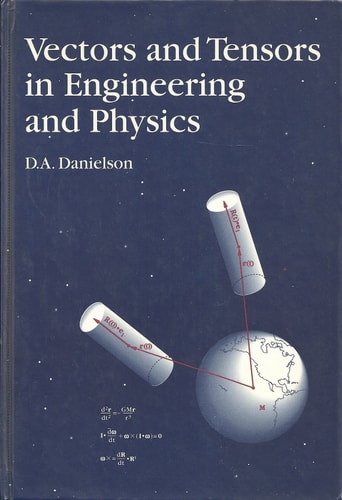
Vectors and Tensors in Engineering and Physics
0
0
As an Amazon Associate and affiliate partner, Menrva Books earns from qualifying purchases. Learn more
Author Description
Vectors and Tensors in Engineering and Physics, Second Edition develops the calculus of tensor fields and uses this mathematics to model the physical world. This new edition includes expanded derivations and solutions, and new applications, to make this successful text an even more useful and user-friendly book than the first edition. The book provides equations for rotations of gyroscopes and other axisymmetric solids, derived from Euler’s equations for the motion of rigid bodies; the temperature decays in quenched forgings, derived from the heat equation; the deformed shapes of twisted rods and bent beams, derived from the Navier equations of elasticity; the flow fields in cylindrical pipes, derived from the Navier-Stokes equations of fluid mechanics; the trajectories of celestial objects, derived from both Newton’s and Einstein’s theories of gravitation; the electromagnetic fields of stationary and moving charged particles, derived from Maxwell’s equations; the stress in the skin when it is stretched, derived from the mechanics of curved membranes; the effects of motion and gravitation upon the times of clocks, derived from the special and general theories of relativity. [The book] also features: over 100 illustrations; complete solutions to over 400 examples and problems; cartesian components, general components, and components-free notations; lists of notations used by other authors; boxes to highlight key equations; historical notes and an extensive bibliography.
Menrva's Summary
THE THESIS
This text investigates the application of tensor calculus as a primary mathematical framework for modeling physical phenomena in engineering and physics. Author Donald Danielson utilizes his academic background to provide a rigorous derivation of tensor fields, bridging the gap between abstract mathematical theory and practical physical systems. The book serves as a comprehensive guide for students and professionals to translate complex physical laws into solvable mathematical equations.
THE SCOPE MAP
What You Will Find
- Calculus of tensor fields including Cartesian and general component notations.
- Mathematical modeling of rigid body motion, elasticity, and fluid mechanics.
- Applications of the heat equation, Navier-Stokes equations, and Maxwell's equations.
- Theoretical derivations for both Newtonian and Einsteinian gravitation and relativity.
THE AUTHORITY PERSPECTIVE
Experts and educators frequently highlight this text as a robust resource for students requiring a bridge between pure mathematics and applied engineering. Readers often note the density of the derivations, which serves as a foundational reference for those working in mechanics and field theory.
Page Count:
288
Publication Date:
1992-07-20
Publisher:
Addison-Wesley
ISBN-10:
0201524260
ISBN-13:
9780201524260
textbook
Calculus
Mathematics
Engineering
Physics
Calculus of tensors
Community Tags
Similar Books