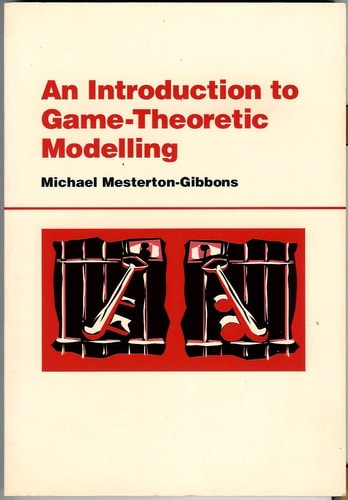
An Introduction to Game-Theoretic Modelling
0
0
As an Amazon Associate and affiliate partner, Menrva Books earns from qualifying purchases. Learn more
Author Description
The emphasis of this book is on self-discovery. In a unified manner, the book deals with the central concepts of both classical and evolutionary game theory. It includes chapters on Nash equilibrium and other solution concepts for noncooperative games; on evolutionary stability and other criteria for equilibrium selection; on cooperative games in strategic form; and on the prisoner's dilemma and the rationality of cooperation. The key ideas are illustrated throughout by well-chosen examples of both human and non-human behavior. Examples include car pooling, motorists at a crossroad, store managers fixing prices, sex allocation, spiders competing for web sites, and insects foraging for oviposition sites. There are numerous exercises, many with solutions.
Menrva's Summary
THE THESIS
This text investigates the fundamental principles of game-theoretic modeling by bridging the gap between classical strategic analysis and evolutionary biology. Michael Mesterton-Gibbons provides a structured framework for understanding how rational agents—whether human or biological—make decisions in competitive environments. By synthesizing mathematical rigor with accessible examples, the author demonstrates how equilibrium concepts apply to diverse scenarios ranging from economic pricing to insect foraging behavior.
THE SCOPE MAP
What You Will Find
- Comprehensive coverage of Nash equilibrium and noncooperative game solution concepts.
- Analysis of evolutionary stability and equilibrium selection criteria.
- Exploration of cooperative games in strategic form and the prisoner's dilemma.
- Practical application through numerous exercises and illustrative examples of human and non-human behavior.
THE AUTHORITY PERSPECTIVE
Experts frequently cite this work as a foundational text for students seeking a clear, self-guided introduction to game theory. Readers often note the balance between theoretical depth and the practical utility of the provided exercises for mastering complex modeling techniques.
Page Count:
200
Publication Date:
1991-12-15
Publisher:
Basic Books
ISBN-10:
0201554488
ISBN-13:
9780201554489
Economics
Evolutionary Biology
Game theory
Mathematics
Academic
Community Tags
Similar Books