A Modest Apostle: Thecla and the History of Women in the Early Church
0
0
As an Amazon Associate and affiliate partner, Menrva Books earns from qualifying purchases. Learn more
Author Description
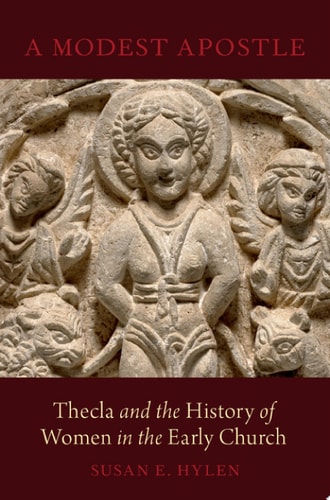
Scholars and mainline pastors tell a familiar narrative about the roles of women in the early church-that women held leadership roles and exercised some authority in the church, but, with the establishment of formal institutional roles, they were excluded from active leadership. Evidence of women's leadership is either described as "exceptional" or relegated to (so-called) heretical groups, who differed with proto-orthodox groups precisely over the issue of women's participation. For example, scholars often contrast the Acts of Paul and Thecla (ATh) with 1Timothy. They understand the two works to represent discrete communities with opposite responses to the question of women's leadership.In A Modest Apostle, Susan Hylen uses Thecla as a microcosm from which to challenge this larger narrative. In contrast to previous interpreters, Hylen reads 1Timothy and the ATh as texts that emerge out of and share a common cultural framework. In the Roman period, women were widely expected to exhibit gendered virtues like modesty, industry, and loyalty to family. However, women pursued these virtues in remarkably different ways, including active leadership in their communities. Reading against a cultural background in which multiple and conflicting norms already existed for women's behavior, Hylen shows that texts like the ATh and 1Timothy begin to look different. Like the culture, 1Timothy affirms women's leadership as deacons and widows while upholding standards of modesty in dress and speech. In the ATh, Thecla's virtue is first established by her modest behavior, which allows her to emerge as a virtuous leader. The text presents Thecla as one who fulfills culturally established norms, even as she pursues a bold new way of life.Hylen's approach points to a new way of understanding women in the early church, one that insists upon the acknowledgment of women's leadership as a historical reality without neglecting the effects of the culture's gender biases.
Menrva's Summary
THE THESIS
Susan E. Hylen investigates whether the early church's exclusion of women from leadership was an inevitable institutional shift or a misinterpretation of shared cultural norms regarding gendered virtue. Hylen, a scholar of New Testament and early Christian history, utilizes a comparative analysis of the Acts of Paul and Thecla and the Pastoral Epistles. She argues that these texts do not represent opposing theological camps, but rather reflect a common Roman cultural framework where modesty and leadership were not mutually exclusive for women.
THE SCOPE MAP
What You Will Find
- Comparative analysis of the Acts of Paul and Thecla and 1 Timothy
- Examination of Roman-era gendered virtues such as modesty, industry, and loyalty
- Historical context regarding the roles of deacons and widows in early Christian communities
Scope Limits
- The study focuses primarily on the specific cultural intersection of the Roman period rather than a comprehensive history of all women in the early church.
THE AUTHORITY PERSPECTIVE
Scholars recognize this work as a significant intervention in the study of gender in early Christianity, noting its departure from traditional binary interpretations of proto-orthodox and heretical texts. Readers frequently highlight the clarity of Hylen's cultural analysis as a useful tool for re-evaluating the historical reality of women's leadership.
Page Count:
200
Publication Date:
2015-09-11
Publisher:
Oxford University Press
ISBN-10:
0190243821
ISBN-13:
9780190243821
Religion
History
Christianity
Theology
Women in Christianity
Womens Studies
Church History
Thecla Saint
Community Tags
Similar Books