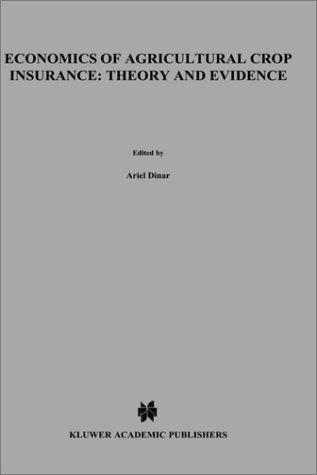
Economics of Agricultural Crop Insurance
0
0
As an Amazon Associate and affiliate partner, Menrva Books earns from qualifying purchases. Learn more
Author Description
Government subsidized crop insurance has been used by a number of developed countries as a mechanism to reduce farm income instability by reducing yield risks. Economics of Agricultural Crop Insurance: Theory and Evidence provides an in-depth analysis and evaluation of government provided crop insurance in developed countries. The book is organized into three sections. Part one presents background material on crop insurance programs in the U.S., Canada and selected other countries. Part two provides some analytical models of multiple peril crop insurance which suggest the possibility of modification of design which could improve performance and which explores theoretical linkages between crop insurance decisions and other producer decisions previously not analyzed. The main part of the book is part three where the results of a series of empirical studies using data bases particularly designed to answer crop insurance related questions are presented. This part of the book tests a number of the hypotheses which were raised in parts one and two regarding reasons for the widely held view by economists that crop insurance has not functioned well.
Menrva's Summary
THE THESIS
This book analyzes the economic theory and empirical evidence behind government-subsidized agricultural crop insurance programs. It delves into the design and performance of these programs, particularly in developed countries, examining their effectiveness in mitigating farm income instability and yield risks. The author, Darrell L. Hueth, a noted economist in the field, utilizes extensive data and analytical models to explore the theoretical underpinnings and practical outcomes of crop insurance, testing hypotheses about why these programs have often been viewed as underperforming.
THE SCOPE MAP
- Background on crop insurance programs in the U.S., Canada, and other developed nations.
- Analytical models of multiple peril crop insurance, suggesting design improvements.
- Theoretical linkages between crop insurance decisions and other producer decisions.
- Results of empirical studies specifically designed to answer crop insurance questions.
- Testing of hypotheses regarding the perceived poor functioning of crop insurance from an economic perspective.
THE AUTHORITY PERSPECTIVE
The book provides a comprehensive analysis of agricultural crop insurance, focusing on its economic implications and empirical performance. It is structured to first present background information on existing programs, then introduce theoretical models for improvement, and finally, detail empirical studies that test key hypotheses. The work aims to address the common economic critique that crop insurance has not functioned optimally, offering data-driven insights into its design and effectiveness.
Page Count:
400
Publication Date:
1994-01-01
ISBN-10:
0792394356
ISBN-13:
9780792394358
Economics
Non-Fiction
Agriculture
Insurance
Policy
Community Tags
Similar Books