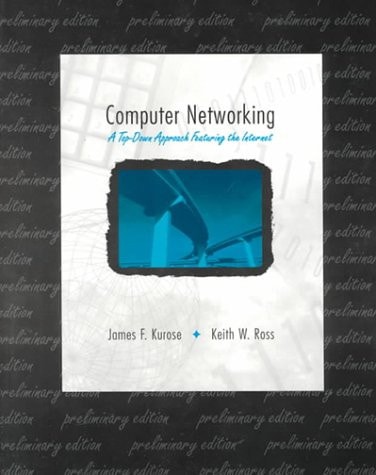
Computer Networking: A Top-Down Approach Featuring the Internet
0
0
As an Amazon Associate and affiliate partner, Menrva Books earns from qualifying purchases. Learn more
Author Description
Certain data-communication protocols hog the spotlight, but all of them have a lot in common. Computer Networking: A Top-Down Approach Featuring the Internet explains the engineering problems that are inherent in communicating digital information from point to point. The top-down approach mentioned in the subtitle means that the book starts at the top of the protocol stack--at the application layer--and works its way down through the other layers, until it reaches bare wire.The authors, for the most part, shun the well-known seven-layer Open Systems Interconnection (OSI) protocol stack in favor of their own five-layer (application, transport, network, link, and physical) model. It's an effective approach that helps clear away some of the hand waving traditionally associated with the more obtuse layers in the OSI model. The approach is definitely theoretical--don't look here for instructions on configuring Windows 2000 or a Cisco router--but it's relevant to reality, and should help anyone who needs to understand networking as a programmer, system architect, or even administration guru.The treatment of the network layer, at which routing takes place, is typical of the overall style. In discussing routing, authors James Kurose and Keith Ross explain (by way of lots of clear, definition-packed text) what routing protocols need to do: find the best route to a destination. Then they present the mathematics that determine the best path, show some code that implements those algorithms, and illustrate the logic by using excellent conceptual diagrams. Real-life implementations of the algorithms--including Internet Protocol (both IPv4 and IPv6) and several popular IP routing protocols--help you to make the transition from pure theory to networking technologies. --David WallTopics covered: The theory behind data networks, with thorough discussion of the problems that are posed at each level (the application layer gets plenty of attention). For each layer, there's academic cove
Menrva's Summary
THE THESIS
This text investigates the core engineering challenges inherent in transmitting digital information across networks by utilizing a top-down pedagogical framework. Authors Keith W. Ross and James Kurose leverage their academic expertise to move from high-level application protocols down to the physical layer, bypassing traditional OSI models in favor of a more practical five-layer architecture. The book provides a rigorous theoretical foundation for programmers and system architects, focusing on the logic and mathematics that govern modern data communication.
THE SCOPE MAP
What You Will Find
- A five-layer networking model covering application, transport, network, link, and physical layers.
- Mathematical analysis of routing algorithms and path determination logic.
- Conceptual diagrams illustrating complex protocol interactions and data flow.
- Real-world implementations including IPv4, IPv6, and standard IP routing protocols.
THE AUTHORITY PERSPECTIVE
Experts and educators frequently cite this work as a foundational text for understanding the mechanics of the internet. Readers often note the academic density of the prose, which balances theoretical rigor with clear, practical examples for technical professionals.
Page Count:
599
Publication Date:
2000-01-01
Publisher:
Addison Wesley Publishing Comp
ISBN-10:
0201612747
ISBN-13:
9780201612745
Internet
Technology
textbook
Networking
Computer Networks
Engineering
Computer Science
Community Tags
Similar Books