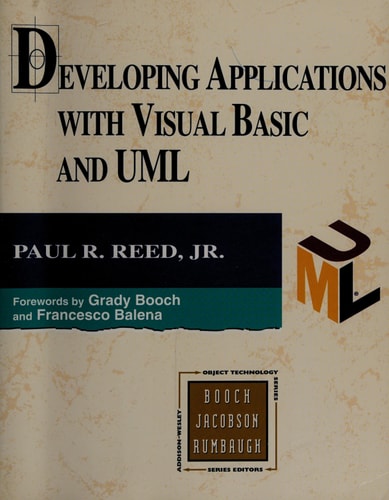
Developing Applications with Visual Basic and UML
0
0
As an Amazon Associate and affiliate partner, Menrva Books earns from qualifying purchases. Learn more
Author Description
An essential resource for Visual Basic (VB) programmers who want to develop applications that are both resilient and robust, Developing Applications with Visual Basic and UML describes a proven development process for designing and implementing object-oriented client/server applications in VB using the Unified Modeling Language (UML). Guided by his own experiences as a developer applying UML and VB, the author provides clear explanations of the fundamentals of UML while also examining and illustrating the often misrepresented object-oriented properties of Visual Basic. In addition, the book incorporates in-depth information on developing VB applications utilizing DNA concepts, incorporating technologies such as DCOM and MTS, and integrating Web tools such as ASP, VB Script, and JavaScript to Internet-enable Visual Basic applications. A significant case study runs throughout the book, leading the reader through the lifecycle of a projectofrom requirements analysis to modeling and prototyping through finalizing the architecture and generating code. Through this study, the author demonstrates the design benefits of UML and shows how to translate a UML specification into Visual Basic code.
Menrva's Summary
THE THESIS
This book investigates how software developers can effectively integrate Unified Modeling Language (UML) into the Visual Basic (VB) development lifecycle to create resilient, object-oriented client/server applications. Paul R. Reed Jr. draws upon his professional experience as a developer to bridge the gap between abstract modeling and concrete implementation. He provides a structured framework for translating UML specifications into functional code while addressing the specific object-oriented capabilities of the Visual Basic environment. The text serves as a technical guide for practitioners aiming to improve their architectural design processes.
THE SCOPE MAP
What You Will Find
- A comprehensive case study illustrating the full project lifecycle from requirements analysis to final code generation.
- Technical methodologies for implementing DNA concepts, DCOM, and MTS within Visual Basic projects.
- Integration strategies for web-enabling applications using ASP, VBScript, and JavaScript.
- Practical explanations of object-oriented properties as they specifically apply to the Visual Basic language.
THE AUTHORITY PERSPECTIVE
Experts recognize this work as a practical bridge for developers transitioning from traditional coding to model-driven development. Readers frequently note the technical density of the prose, which assumes a foundational understanding of both Visual Basic and basic software architecture principles.
Page Count:
580
Publication Date:
2008-01-07
Publisher:
Pearson Technology Group
ISBN-10:
0201615797
ISBN-13:
9780201615791
Computer Science
Visual Basic
Technology
Programming
Software Engineering
Community Tags
Similar Books