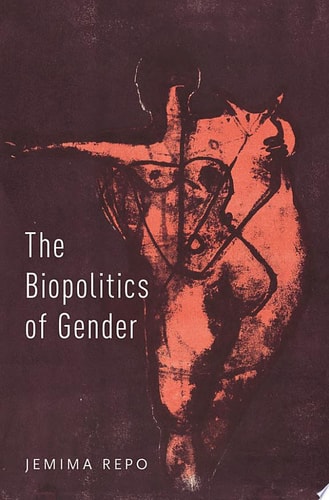
The Biopolitics of Gender
0
0
As an Amazon Associate and affiliate partner, Menrva Books earns from qualifying purchases. Learn more
Author Description
Michel Foucault identified sexuality as one of the defining biopolitical technologies of the nineteenth and twentieth centuries. As Jemima Repo argues in this book, "gender" has come to be the major sexual signifier of the mid-twentieth and early twenty-first century. In fact, in this historical excavation of the biopolitical significance of the term, she argues that it could not have emerged at any other time. Repo shows that gender is not originally a feminist term, but emerged from the study of intersex and transsexual persons in the fields of sexology and psychology in the1950s and 1960s. Prior to the 1950s gender was used to refer to various types of any number of phenomena - sometimes sex, but not necessarily. Its only regular usage was in linguistics, where it was used to classify nouns as masculine, feminine, or neuter. In the mid-twentieth century, gender shifted from being a nominator of types to designating the sexual order of things. As with sexuality in the Victorian period, over the last sixty years, the notion of gender has become an entire field of knowledge. Feminists famously took up the term in the 1970s to challenge biological determinism, and in government, "women" have been replaced by "gender" in policy-making processes that aim to advance equality between women and men. Gender has also become a key variable in social scientific surveys of different socio-political phenomena like voting, representation, employment, salaries, and parental leave decisions. The Biopolitics of Gender analyzes the strategies and tactics of power involved in the use of "gender" in sexology and psychology, and subsequently its reversal and counter-deployment by feminists in the 1970s and 1980s. It critiques the emergence of gender in demographic science and the implications of this genealogy for feminist theory and politics today. Drawing on a wide variety of historical and contemporary sources, the book makes a major theoretical argument about gender as a historical
Menrva's Summary
THE THESIS
How did the concept of 'gender' evolve from a linguistic classification into a central biopolitical technology of the mid-twentieth and early twenty-first centuries? Jemima Repo, a scholar in gender and politics, investigates the historical emergence of the term within sexology and psychology during the 1950s and 1960s. By tracing the shift from linguistic usage to a tool for managing sexual order, the author argues that gender functions as a mechanism of power that has been both deployed by state institutions and reclaimed by feminist movements.
THE SCOPE MAP
What You Will Find
- A historical genealogy of the term 'gender' from linguistics to social science.
- Analysis of the influence of sexology and psychology on modern identity categories.
- Examination of the institutionalization of gender in policy-making and demographic research.
- Critique of the shift from 'women' to 'gender' in equality-focused political frameworks.
Scope Limits
- The text does not provide a comprehensive history of all feminist theories, focusing instead on the specific genealogy of the term 'gender'.
- It does not offer a prescriptive guide for future policy, but rather a critical analysis of existing power structures.
THE AUTHORITY PERSPECTIVE
Scholars in political theory and gender studies frequently cite this work for its rigorous application of Foucaultian biopolitics to contemporary social categories. Readers often note the academic density of the prose, which requires familiarity with critical theory and historical analysis.
Page Count:
232
Publication Date:
2015-10-06
Publisher:
Oxford University Press
ISBN-10:
0190256915
ISBN-13:
9780190256913
Philosophy
Gender Studies
Power Social sciences
Science History
Feminist Theory
Sex Role
Sociology
Community Tags
Other Editions(4)


Similar Books














Reader Comments
Share Your Thoughts
No comments yet. Be the first to share your thoughts!