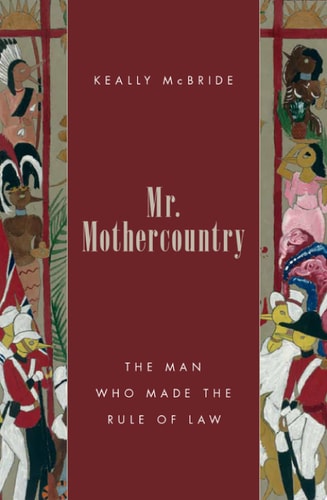
Mr. Mothercountry: The Man Who Made the Rule of Law
0
0
As an Amazon Associate and affiliate partner, Menrva Books earns from qualifying purchases. Learn more
Author Description
Today, Every Continent Retains Elements Of The Legal Code Distributed By The British Empire. The British Empire Created A Legal Footprint Along With Political, Economic, Cultural And Racial Ones. One Of The Central Problems Of Political Theory Is The Insurmountable Gap Between Ideas And Their Realization. Keally Mcbride Argues That Understanding The Presently Fraught State Of The Concept Of The Rule Of Law Around The Globe Relies Upon Understanding How It Was First Introduced And Then Practiced Through Colonial Administration--as Well As Unraveling The Ideas And Practices Of Those Who Instituted It. The Astonishing Fact Of The Matter Is That For Thirty Years, Between 1814 And 1844, Virtually All Of The Laws In The British Empire Were Reviewed, Approved Or Discarded By One Individual: James Stephen, Disparagingly Known As Mr. Mothercountry. Virtually Every Single Act That Was Passed By A Colony Made Its Way To His Desk, From A Levy To Improve Sanitation, To An Officer's Pay, To Laws Around Migration And Immigration, And Tariffs On Products. Stephen, Great-grandfather Of Virginia Woolf, Was An Ardent Abolitionist, And He Saw His Role As A Legal Protector Of The Most Dispossessed. When Confronted By Acts That Could Not Be Overturned By Reference To British Law That He Found Objectionable, He Would Make Arguments In The Name Of The Natural Law Of Justice And Equity. He Truly Believed That Law Could Be A Force For Good And Equity At The Same Time That He Was Frustrated By The Existence Of Laws That He Saw As Abhorrent. In Mr. Mothercountry, Mcbride Draws On Original Archival Research Of The Writings Of Stephen And His Descendants, As Well As The Macaulay Family, Two Major Lineages Of Legal Administrators In The British Colonies, To Explore The Gap Between The Ideal Of The Rule Of Law And The Ways In Which It Was Practiced And Enforced. Mcbride Does This To Show That There Is No Way Of Claiming That Law Is Always A Force For Good Or Simply An Ideological Cover For Oppression.
Menrva's Summary
THE THESIS
How did the centralization of legal authority in the hands of a single colonial administrator shape the global implementation of the rule of law? Keally McBride, a professor of politics, examines the career of James Stephen, who served as the primary legal arbiter for the British Empire between 1814 and 1844. By analyzing archival records and the correspondence of the Stephen and Macaulay families, the author argues that the modern, often contradictory, application of the rule of law is rooted in the administrative practices of the colonial era. The text investigates the tension between Stephen's personal commitment to abolitionist ideals and the pragmatic, often coercive, realities of imperial governance.
THE SCOPE MAP
What You Will Find
- An analysis of the administrative machinery of the British Colonial Office during the early 19th century.
- A detailed examination of the legal philosophy of James Stephen and his influence on colonial legislation.
- A comparative study of the gap between theoretical legal ideals and their practical enforcement in diverse colonial territories.
Scope Limits
- The text does not provide a comprehensive history of every British colony, focusing instead on the central administrative processes.
- The analysis is limited to the period between 1814 and 1844, excluding later developments in imperial legal policy.
THE AUTHORITY PERSPECTIVE
Scholars and historians recognize this work as a significant contribution to the study of colonial administration and the intellectual history of law. Readers frequently note the academic rigor of the research, which provides a nuanced look at how individual agency influenced the development of global legal structures.
Page Count:
256
Publication Date:
2016-01-01
Publisher:
Oxford University Press, Incorporated
ISBN-10:
0190252987
ISBN-13:
9780190252984
History
Biography
British Empire
Colonialism
Legal History
Community Tags
Other Editions(2)
Similar Books
Reader Comments
Share Your Thoughts
No comments yet. Be the first to share your thoughts!