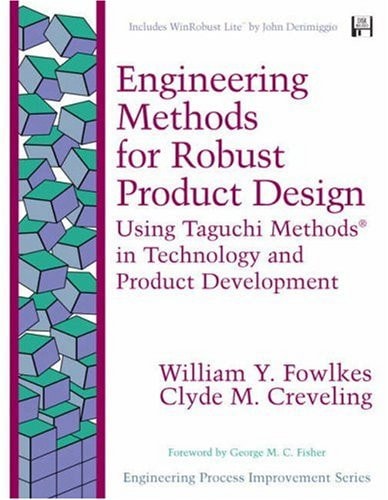
Engineering Methods for Robust Product Design: Using Taguchi Methods in Technology and Product Development
0
0
As an Amazon Associate and affiliate partner, Menrva Books earns from qualifying purchases. Learn more
Author Description
The book contains complete information on the process of engineering robust products that are insensitive to sources of variability in manufacturing and customer use. You will find detailed instructions for planning, designing, conducting, and analyzing the experiments that are used to optimize a product's performance under a variety of "stressed" conditions. An entire section focuses on designing products that achieve additivity, the property that reduces negative interactions. In addition, the book offers a systematic method for optimizing cost, quality, and cycle time. It even discusses the relationship of robust design to such other quality processes as Quality Function Deployment and Six Sigma.
Menrva's Summary
THE THESIS
This book investigates the methodology for engineering robust products that maintain performance consistency despite environmental variability and manufacturing fluctuations. The authors, Clyde M. Creveling and William Y. Fowlkes, provide a technical framework for applying Taguchi methods to product development. By integrating experimental design with systematic optimization, the text outlines how engineers can reduce negative interactions and improve product reliability under stressed conditions.
THE SCOPE MAP
What You Will Find
- Detailed protocols for planning, executing, and analyzing robust design experiments.
- Methodologies for achieving additivity to minimize negative component interactions.
- Systematic approaches for balancing cost, quality, and development cycle time.
- Integration strategies linking robust design with Quality Function Deployment and Six Sigma frameworks.
THE AUTHORITY PERSPECTIVE
Engineers and quality professionals frequently cite this text as a practical manual for implementing Taguchi methods in industrial settings. The prose is dense and technical, serving as a reference for practitioners who require actionable steps for optimizing product performance.
Page Count:
403
Publication Date:
1995-01-01
Publisher:
Prentice Hall
ISBN-10:
0201633671
ISBN-13:
9780201633672
Product design
Technology
Engineering
New Products
Quality Control
Manufacturing
Community Tags
Similar Books