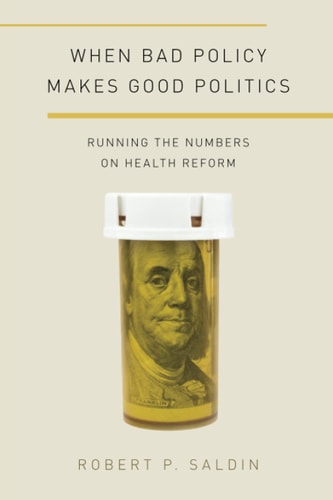
When Bad Policy Makes Good Politics
0
0
As an Amazon Associate and affiliate partner, Menrva Books earns from qualifying purchases. Learn more
Author Description
Since the 1960s, America's policymaking system has transitioned from one in which leaders like Lyndon Johnson could simply disparage the concept of budget projections to one in which policymakers consciously manipulate cost estimates. Paradoxically, the very safeguards put in place to thwart economically unsound legislation now cause chaos by incentivizing the development of flawed, even blatantly unworkable, policies. As Robert Saldin shows in When Bad Policy Makes Good Politics, the pathologies of the new system are illustrated by the Community Living Assistance Services and Supports Act and its role in aiding passage of President Obama's landmark health reform law. CLASS was supposed to bring much needed relief of America's dysfunctional long-term care system, but critics argued that its flawed design rendered the program unviable. However, what appeared to be a naïve proposal was actually a carefully framed policy designed to fit the rules of the game, particularly the Congressional Budget Office's cost-projection process. Although CLASS was destined for a "death spiral" requiring massive government bailouts, the CBO estimated it would save tens of billions of dollars. These official "savings" made CLASS an appealing add-on to the Affordable Care Act. But when the Obama administration later announced that CLASS was impossible to implement, America's long-term care system was left in crisis. This skillful examination of CLASS and the machinations of Congress provides insight into how the contemporary policymaking process really functions.
Menrva's Summary
THE THESIS
This book investigates how modern American policymaking safeguards, intended to ensure fiscal responsibility, paradoxically incentivize the creation of flawed and unworkable legislation. Robert P. Saldin, a political scientist, utilizes the legislative history of the Community Living Assistance Services and Supports (CLASS) Act to demonstrate how policymakers manipulate Congressional Budget Office (CBO) projections to secure political victories. The work argues that the current system prioritizes the appearance of fiscal compliance over the actual viability of public programs.
THE SCOPE MAP
What You Will Find
- Analysis of the Congressional Budget Office (CBO) cost-projection process
- Case study of the CLASS Act within the Affordable Care Act
- Examination of legislative maneuvering and budget manipulation
- Historical overview of American policymaking shifts since the 1960s
Scope Limits
- Does not provide a comprehensive history of all US healthcare legislation
- Does not offer specific policy prescriptions for reforming the CBO
THE AUTHORITY PERSPECTIVE
Experts highlight this work as a critical examination of the unintended consequences inherent in contemporary legislative processes. Readers frequently note the clarity with which the author explains complex bureaucratic mechanisms and their impact on national policy outcomes.
Page Count:
182
Publication Date:
2017-03-30
Publisher:
Oxford University Press
ISBN-10:
0190255447
ISBN-13:
9780190255442
History
Legislative Studies
Health Policy
American Government
Public Policy
Community Tags
Similar Books