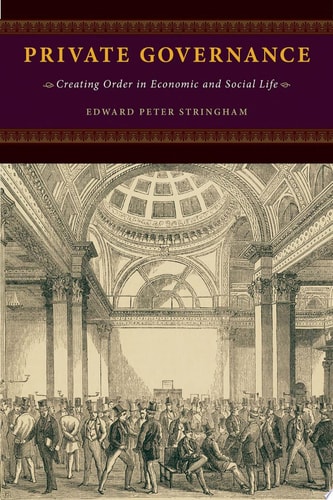
Private Governance: Creating Order in Economic and Social Life
0
0
As an Amazon Associate and affiliate partner, Menrva Books earns from qualifying purchases. Learn more
Author Description
From the first stock markets of Amsterdam, London, and New York to the billions of electronic commerce transactions today, privately produced and enforced economic regulations are more common, more effective, and more promising than commonly considered. In Private Governance, prominent economist Edward Stringham presents case studies of the various forms of private enforcement, self-governance, or self-regulation among private groups or individuals that fill a void that government enforcement cannot. Through analytical narratives the book provides a close examination of the world's first stock markets, key elements of which were unenforceable by law; the community of Celebration, Florida, and other private communities that show how public goods can be bundled with land and provided more effectively; and the millions of credit-card transactions that occur daily and are regulated by private governance. Private Governance ultimately argues that while potential problems of private governance, such as fraud, are pervasive, so are the solutions it presents, and that much of what is orderly in the economy can be attributed to private groups and individuals. With meticulous research, Stringham demonstrates that private governance is a far more common source of order than most people realize, and that private parties have incentives to devise different mechanisms for eliminating unwanted behavior. Private Governance documents numerous examples of private order throughout history to illustrate how private governance is more resilient to internal and external pressure than is commonly believed. Stringham discusses why private governance has economic and social advantages over relying on government regulations and laws, and explores the different mechanisms that enable private governance, including sorting, reputation, assurance, and other bonding mechanisms. Challenging and rigorously-written, Private Governance will make a compelling read for those with an interest in economic
Menrva's Summary
THE THESIS
This book investigates the mechanisms by which private groups and individuals create order and enforce regulations in economic and social life without reliance on government intervention. Edward P. Stringham, a prominent economist, utilizes historical analysis and contemporary case studies to challenge the assumption that state regulation is the primary source of market stability. He argues that private incentives, such as reputation and bonding mechanisms, effectively mitigate risks like fraud and provide public goods more efficiently than centralized authorities.
THE SCOPE MAP
What You Will Find
- Historical analysis of early stock markets in Amsterdam, London, and New York.
- Examination of private community management, specifically in Celebration, Florida.
- Analysis of private regulation in global credit-card transaction networks.
- Theoretical framework covering sorting, reputation, and assurance mechanisms.
Scope Limits
- The text does not provide a comprehensive legal history of state-based regulatory frameworks.
- It does not address every potential failure mode of private governance in extreme or non-market contexts.
THE AUTHORITY PERSPECTIVE
Experts and readers frequently note the academic rigor and clear analytical structure of the prose. The book is widely regarded as a foundational text for those interested in the intersection of institutional economics and private order.
Page Count:
298
Publication Date:
2015-06-01
Publisher:
Oxford University Press
ISBN-10:
0190250216
ISBN-13:
9780190250218
Economics
Business
History
Economics history
Public Policy
Sociology
Civil Law
Economics
Corporate governance
Community Tags
Similar Books