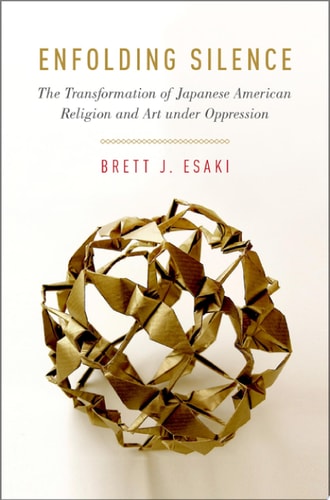
Enfolding Silence: The Transformation of Japanese American Religion and Art under Oppression
0
0
As an Amazon Associate and affiliate partner, Menrva Books earns from qualifying purchases. Learn more
Author Description
This book demonstrates how Japanese Americans have developed traditions of complex silences to survive historic moments of racial and religious oppression and how they continue to adapt these traditions today. Brett Esaki offers four case studies of Japanese American art-gardening, origami, jazz, and monuments-and examines how each artistic practice has responded to a historic moment of oppression. He finds that these artistic silences incorporate and convey obfuscated and hybridized religious ideas from Buddhism, Christianity, Confucianism, Shinto, indigenous religions, and contemporary spirituality.While silence is often thought of as the binary opposite and absence of sound, Esaki offers a theory of non-binary silence that articulates how multidimensional silences are formed and how they function. He argues that non-binary silences have allowed Japanese Americans to disguise, adapt, and innovate religious resources in order to negotiate racism and oppressive ideologies from both the United States and Japan. Drawing from the fields of religious studies, ethnic studies, theology, anthropology, art, music, history, and psychoanalysis, this book highlights the ways in which silence has been used to communicate the complex emotions of historical survival, religious experience, and artistic inspiration.
Menrva's Summary
THE THESIS
This book investigates how Japanese Americans utilize complex, non-binary silences as a strategic religious and artistic response to systemic racial and religious oppression. Brett J. Esaki, a scholar in religious and ethnic studies, constructs a theoretical framework that redefines silence not as an absence, but as a multidimensional tool for survival and cultural adaptation. By integrating interdisciplinary methodologies from anthropology, theology, and psychoanalysis, the author argues that these silences serve to preserve and hybridize religious traditions under the pressure of external ideologies.
THE SCOPE MAP
What You Will Find
- Analysis of four distinct artistic practices: gardening, origami, jazz, and monuments.
- A theoretical model of non-binary silence as a communicative and protective mechanism.
- Synthesis of religious influences including Buddhism, Christianity, Confucianism, and Shinto.
Scope Limits
- The study focuses primarily on the Japanese American experience and does not provide an exhaustive history of all Japanese religious practices.
- The analysis is limited to the specific artistic mediums selected as case studies rather than a comprehensive survey of all Japanese American art forms.
THE AUTHORITY PERSPECTIVE
Scholars in the field of religious and ethnic studies recognize this work as a significant contribution to the understanding of how marginalized groups encode cultural and spiritual resistance within non-verbal practices. Readers frequently note the academic density of the prose, which effectively bridges the gap between historical analysis and contemporary cultural theory.
Page Count:
280
Publication Date:
2016-06-01
Publisher:
Oxford University Press
ISBN-10:
0190251425
ISBN-13:
9780190251420
Religion
History
Silence
Sociology
Racism
American Studies
Art History
Social change
United States
Arts japan