Developing Enterprise Java Applications with J2EE and UML
0
0
As an Amazon Associate and affiliate partner, Menrva Books earns from qualifying purchases. Learn more
Author Description
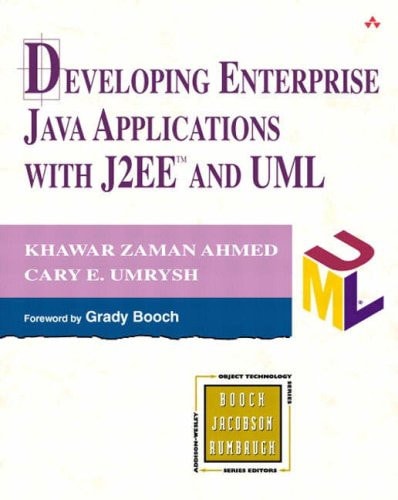
The Java 2 Platform Enterprise Edition (J2EE TM) offers great promise for dramatically improving the way that enterprise applications are built, and organizations that have adopted the J2EE are gaining a competitive advantage. The industry-standard Unified Modeling Language (UML) has helped countless organizations achieve software success through visual modeling. Together, the UML and J2EE form a powerful set of tools, but the intricacies involved with using them in tandem are considerable.While UML is highly effective for specifying, designing, constructing, visualizing, and documenting software systems, J2EE offers enterprise developers a simplified, component-based approach to application development. However, when using the two technologies together, developers must first consider--and attempt to reconcile--the different characteristics of each.Developing Enterprise Java Applications with J2EE TM and UML examines the best ways to jointly leverage these technologies. Exploring concrete methods for completing a successful development project, the authors cover the use of UML and J2EE in detail. Using practical examples and a case study, they illustrate the pros and cons of specific design approaches, show how personal experience can affect design decisions, and demonstrate proven approaches for building better, software faster.With this book as a guide, developers will be able to overcome the challenges in using UML and J2EE together, and be on their way to building robust, scalable, and complex applications.
Menrva's Summary
THE THESIS
This book investigates the technical challenges and strategic methodologies required to integrate Unified Modeling Language (UML) with the Java 2 Platform Enterprise Edition (J2EE) for large-scale software development. The authors, Cary E. Umrysh and Khawar Zaman Ahmed, leverage their professional experience to provide a framework for reconciling the visual modeling capabilities of UML with the component-based architecture of J2EE. By analyzing the intersection of these two technologies, the text aims to streamline the development lifecycle and improve the scalability of enterprise-level applications.
THE SCOPE MAP
What You Will Find
- Methodologies for mapping UML diagrams to J2EE component architectures.
- Practical case studies illustrating real-world design trade-offs and decision-making processes.
- Analysis of the pros and cons associated with specific design patterns in an enterprise environment.
- Strategies for documenting and visualizing complex software systems to ensure project success.
THE AUTHORITY PERSPECTIVE
Industry professionals recognize this work as a practical resource for developers navigating the complexities of early enterprise Java environments. The text is frequently cited for its focus on bridging the gap between high-level architectural design and low-level implementation details.
Page Count:
330
Publication Date:
2001-01-01
Publisher:
Addison-Wesley Professional
ISBN-10:
0201738295
ISBN-13:
9780201738292
Computer Science
Software Engineering
Business
Programming
Java
Community Tags
Similar Books