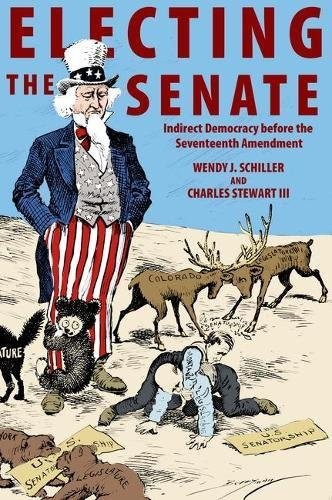
Electing the Senate: Indirect Democracy before the Seventeenth Amendment
0
0
As an Amazon Associate and affiliate partner, Menrva Books earns from qualifying purchases. Learn more
Author Description
From 1789 to 1913, U.S. senators were not directly elected by the people--instead the Constitution mandated that they be chosen by state legislators. This radically changed in 1913, when the Seventeenth Amendment to the Constitution was ratified, giving the public a direct vote. Electing the Senate investigates the electoral connections among constituents, state legislators, political parties, and U.S. senators during the age of indirect elections. Wendy Schiller and Charles Stewart find that even though parties controlled the partisan affiliation of the winning candidate for Senate, they had much less control over the universe of candidates who competed for votes in Senate elections and the parties did not always succeed in resolving internal conflict among their rank and file. Party politics, money, and personal ambition dominated the election process, in a system originally designed to insulate the Senate from public pressure. Electing the Senate uses an original data set of all the roll call votes cast by state legislators for U.S. senators from 1871 to 1913 and all state legislators who served during this time. Newspaper and biographical accounts uncover vivid stories of the political maneuvering, corruption, and partisanship--played out by elite political actors, from elected officials, to party machine bosses, to wealthy business owners--that dominated the indirect Senate elections process. Electing the Senate raises important questions about the effectiveness of Constitutional reforms, such as the Seventeenth Amendment, that promised to produce a more responsive and accountable government.
Menrva's Summary
THE THESIS
This book investigates the complex and often corrupt system of indirect senatorial elections in the United States prior to the Seventeenth Amendment. Wendy J. Schiller and Charles Stewart examine the intricate relationships between constituents, state legislators, political parties, and U.S. senators during the era of indirect elections, from 1789 to 1913. While parties could influence the partisan outcome, they struggled to control candidate selection and internal party conflicts. The study reveals how party politics, financial influence, and personal ambition shaped elections, often subverting the system's original intent to insulate the Senate from public pressure.
THE SCOPE MAP
- Analysis of U.S. senatorial elections from 1789 to 1913, a period of indirect selection by state legislators.
- An original dataset of all roll call votes by state legislators for U.S. senators (1871-1913) and data on all state legislators serving during this time.
- Exploration of the electoral connections among constituents, state legislators, political parties, and U.S. senators.
- Examination of the extent of party control over candidate selection and resolution of internal party conflicts.
- Case studies and narrative accounts of political maneuvering, corruption, and partisanship involving elected officials, party bosses, and business owners.
- Discussion on the effectiveness of constitutional reforms, specifically the Seventeenth Amendment, in creating a more responsive government.
THE AUTHORITY PERSPECTIVE
The book is a scholarly examination of a critical period in American electoral history, utilizing extensive original data and narrative accounts to reconstruct the dynamics of indirect Senate elections. It highlights the interplay of party politics, financial interests, and individual ambition, questioning the ultimate success of constitutional reforms aimed at increasing government accountability. The research provides a detailed look at the mechanisms of power and influence that shaped the Senate before direct popular election.
Page Count:
256
Publication Date:
2014-01-01
ISBN-10:
0691163162
ISBN-13:
9780691163161
History
Non-Fiction
Politics
Science
Political History
Constitutional Law
Electoral Systems
American Politics
Community Tags
Similar Books