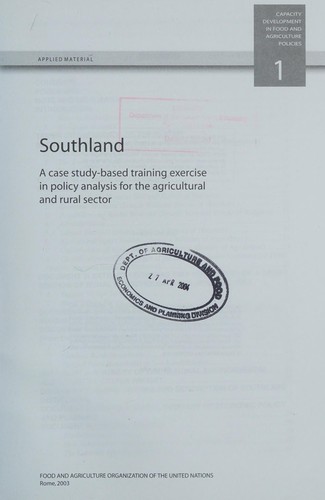
Southland
0
0
As an Amazon Associate and affiliate partner, Menrva Books earns from qualifying purchases. Learn more
Author Description
The "Southland case study" is designed for a group of participants in a course on agricultural policy to mobilize their knowledge and skills on a fictitious country simulating many of the problems faced by developing countries. Based on realistic information on the country, presented in a set of documents collected from various sources and on a set of statistical tables, participants are asked to prepare a note outlining the key policy and institutional issues faced by the country and make proposals on how they can be addressed. This case study, developed in the early 1990s, has evolved as the history of the fictitious "Southland" unfolded, following patterns similar to those of many developing countries. It has been successfully used on many occasions and in different locations. The material presented includes notes to participants and trainers, background information, studies, historical information, and a glossary of economic and institutional terminology.
Menrva's Summary
THE THESIS
The Southland case study challenges participants to apply agricultural policy knowledge to a simulated developing nation. The book presents realistic data and documents for a fictitious country, mirroring challenges faced by real-world developing nations. Participants must analyze policy and institutional issues and propose solutions based on the provided information. Developed in the early 1990s, the case study has been updated to reflect evolving patterns seen in many developing countries and has a proven track record of successful use.
THE SCOPE MAP
- A detailed case study of the fictitious country 'Southland'.
- Realistic information presented through various documents and statistical tables.
- Background information, studies, and historical context for Southland.
- Notes for participants and trainers on how to engage with the material.
- A glossary of economic and institutional terminology.
- Simulated agricultural policy problems relevant to developing countries.
THE AUTHORITY PERSPECTIVE
The Southland case study is designed for educational purposes, specifically for courses on agricultural policy. Its strength lies in its realistic simulation of developing country challenges, allowing participants to mobilize their knowledge and skills. The case study has been successfully used on multiple occasions and in various locations, indicating its effectiveness as a pedagogical tool. The inclusion of background information, historical context, and a glossary further supports its utility for trainers and participants.
Page Count:
112
Publication Date:
2003-01-01
ISBN-10:
9251050694
Economics
Non-Fiction
Policy
Developing Countries
Agriculture
Case Study
Community Tags
Similar Books